Showing posts with label raisin. Show all posts

Saturday, 22 August 2015

Spiced oat traybake


The mornings are staying darker longer, and we’re putting the lights on much earlier in the evening – if that doesn’t mean Autumn’s on its way then I don’t know what does!  I therefore take this as my trigger to start thinking about spices and oats and more substantial baking…in truth, my thoughts never leave such things but it’s nice to be a tiny bit seasonal if possible.


This traybake is simple to make and, next to fancier fare, could look a bit plain but that’s just how I like it.  There are very few decorated fancies that can hold a candle to something with raisins and oats in; they’re so wholesome and like eating a big hug.  If raisins aren’t your thing then replace with any other dried fruit, or be a complete maverick and use chocolate chips or even chopped ginger.  As long as you choose something dry, that won’t ooze during baking, the cake will work.


The smell of this baking will drive you wild.  I went for a cinnamon/mixed spice mix as I find cinnamon on its own can be overpoweringly dominant but, as with the fruit, mix it up to suit your tastebuds.


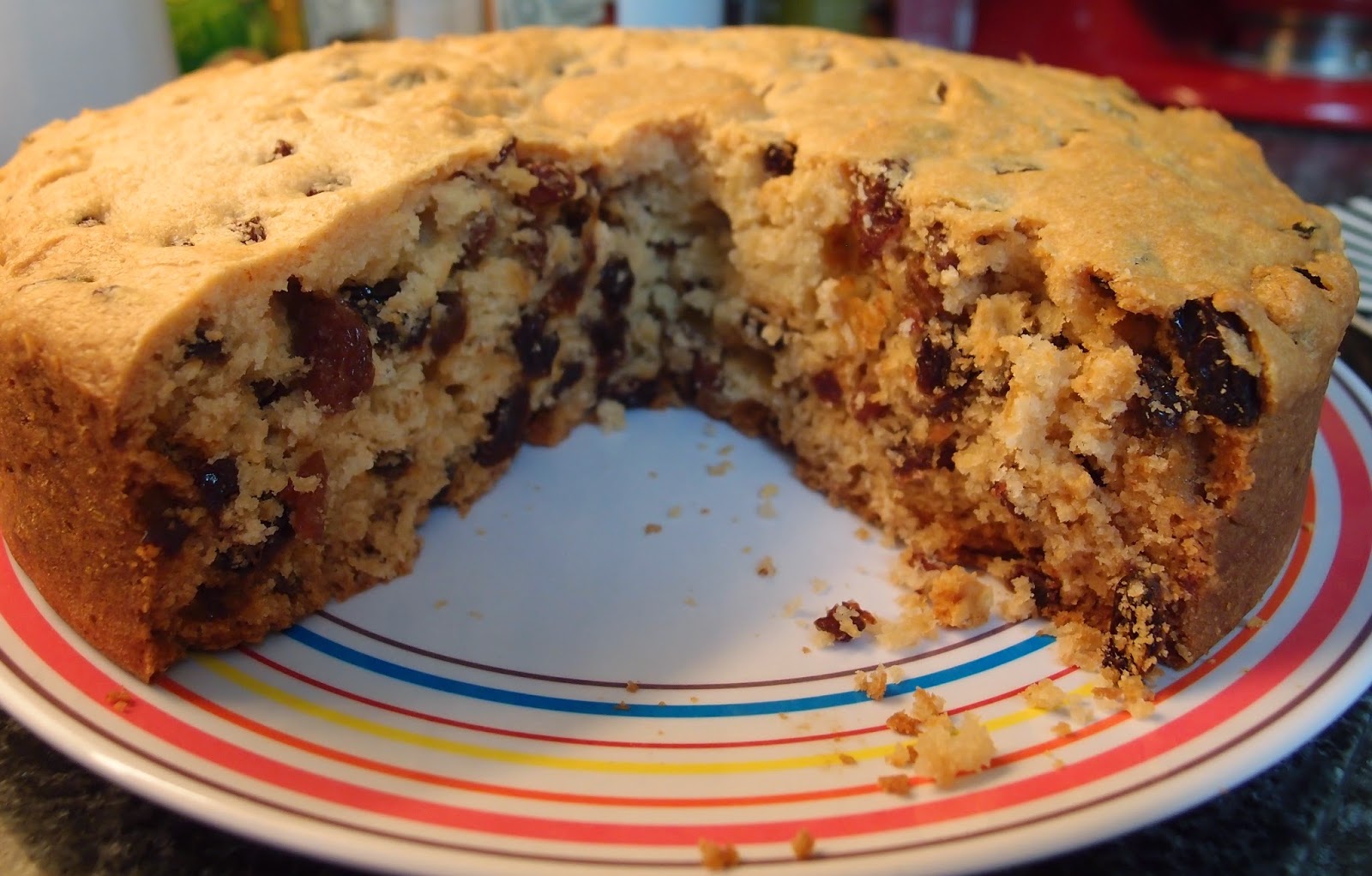
I think the oats and raisins mean you can get away with eating this for breakfast.  I do like a cake that is acceptable at any time of the day (ok, that’s all of them in my world, but I do try and fit in with ‘normal’ views…or at least pretend to!).  Now, you might think this photo is blurry, but I prefer to think of it as ‘how Monet would’ve viewed the cake’:


The final thing it is my duty to point out(!) is that the texture of this cake is lighter than sponge.  I know, I know, you see ‘oats’ in the title of a bake and it’s impossible not to think of flapjacks and that heavy, dense texture.  But this cake is a million miles away from that; it is unbelievably light and airy...and I say that as someone who has done their research*.

*Research = eaten three pieces in one sitting.


Ingredients

300ml boiling water
80g porridge oats
110g unsalted butter, at room temperature
150g dark brown soft sugar
125g caster sugar,  plus an extra 2 tablespoons to sprinkle on top
2 eggs
1 teaspoon vanilla extract
1 teaspoon bicarbonate of soda
pinch of salt
½ teaspoon ground cinnamon
½ teaspoon mixed spice
200g plain flour
70g raisins


Method

Pour the boiling water over the oats and leave to stand for 20 minutes.

Preheat the oven to 180C/fan oven 160C/350F/gas mark 4.

Grease a 30cm x 20cm traybake tin. (I recommend greasing or using non stick foil as this is a sticky sponge and it didn’t seem to get on well with the baking paper I stood it on to cool after baking).

Beat together the butter and both sugars until well combined – it will never go light and whippy with dark sugar.

Beat in the eggs one at a time.

Stir in the oats and vanilla, mixing well to ensure all the ingredients are combined.

In a separate bowl combine the dry ingredients i.e. bicarbonate of soda, salt, cinnamon, mixed spice and flour.

Stir the raisins into the dry mix – this will coat them and stop them clumping in the batter.

Add the dry ingredients to the oat mixture and stir well enough to combine all the ingredients.

Spoon into the prepared tin and level the surface.

Sprinkle over the extra caster sugar.

Bake for approximately 30-40 minutes or until a skewer inserted into the mix comes out clean.

Leave to cool, in the tin, on a wire rack.

Serve in generous slices with a mug of tea.

Bask in the glory of the wonderful thing you have created.


Eat.

Sunday, 16 November 2014

Tea loaf cake


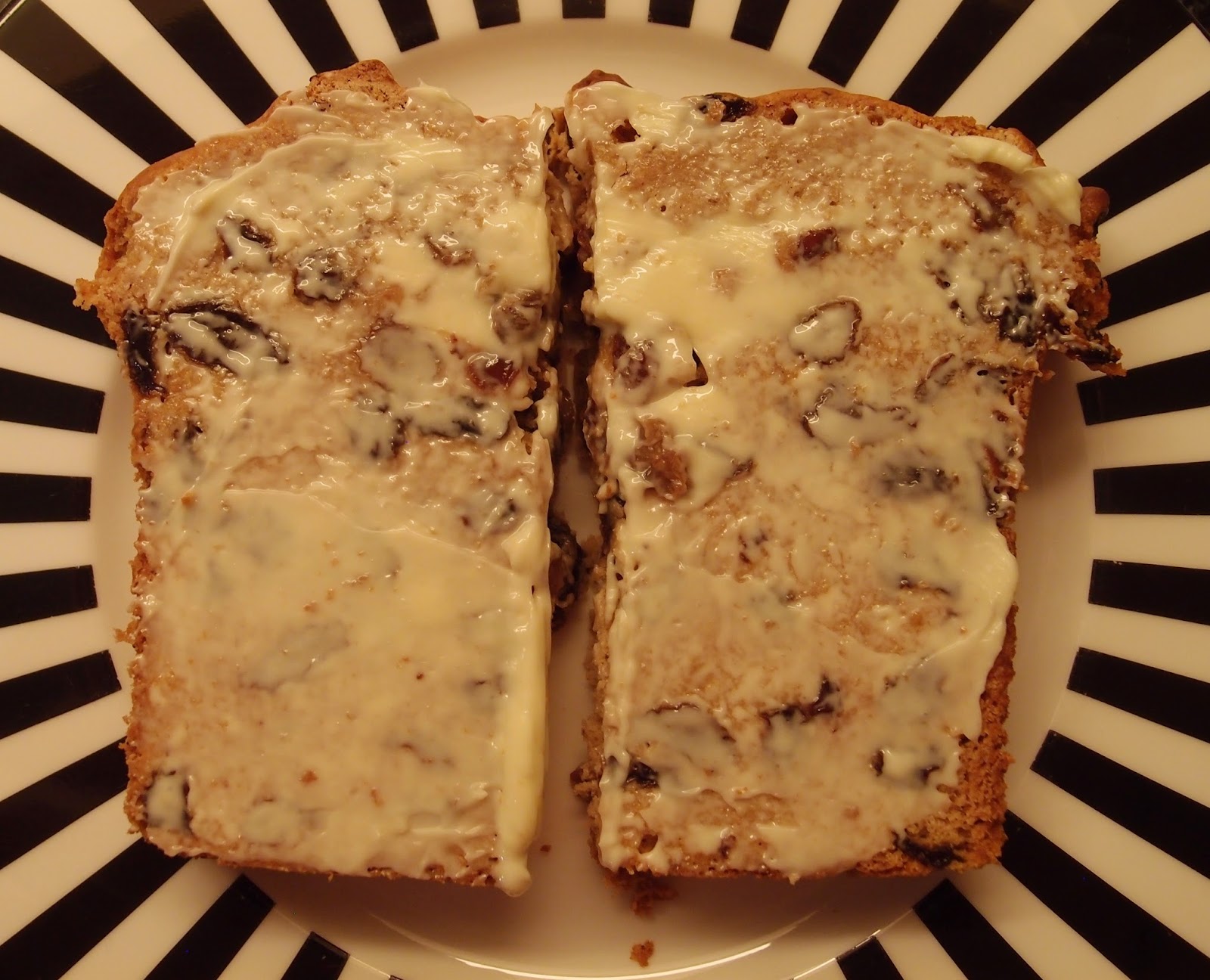
Classics become classics for a reason – usually because they’re great.  There is something about a tea loaf cake that is inherently nostalgic.  I feel it has always been in my life and I can clearly remember, from a young age, the smell of it being toasted and buttered to have with a cup of tea on Sunday afternoons.  Back then I wasn’t a fan of it being toasted but I like it now.


I enjoy making any recipe where soaking of fruit is involved, be it an alcoholic bath for Christmas cake fruits or – as in this instance – tea.  Each time I pass the bowl I cannot resist tinkering with it; carefully mixing the fruit to ensure each sultana and raisin gets a chance to soak and absorb the flavours.  What is unusual in this recipe is that you add the sugar at this stage too – I’d not seen that before.  The only thing to be aware of with this recipe is the soak time i.e. you need to start it a day before you wish to make it.  Other than that, it’s a doddle!


When you spoon the cake into the tin it will seem like the mix is all fruit and no cake.  That’s often the way with these sort of bakes but don’t worry, the magic of the oven will sort it all out and I promise you’ll end up with a lovely tea loaf!  Mine seems to have come out huge (even by my standards) – not sure why!


If you’ve read my blog for any length of time you will know my only rule for buttering a slice of fruit loaf: the butter has to be thick enough that you leave teeth marks in it when you take a bite.  If your dentist couldn’t identify you from the impression you have left in the slice of fruit loaf then you need to reconsider your approach to buttering. 


Ingredients

250g sultanas
250g raisins
250g caster sugar
375ml cold tea – any tea you like!
1 egg
500g self raising flour
1 teaspoon mixed spice
1 teaspoon grated nutmeg


Method

The day before baking place the sultanas, raisins, caster sugar and cold tea in a bowl and mix together. 

Cover the bow and leave to stand overnight.  Stir occasionally.

Preheat the oven to 180C/fan oven 160C/350F/gas mark 4.

Line a 900g loaf tin with baking paper.

Beat the egg and then stir into the bowl of soaked fruit.

Add the flour and spices to the fruit mix and stir well to ensure that everything is well combined and there are no clumps of flour.

Spoon into the prepared tin and level the surface.

Bake for approximately 1 hour or until a skewer inserted into the loaf comes out clean.

Leave to cool in the tin for 15 minutes before de-tinning and leaving to cool completely on a wire rack.

Serve in slices with thick butter.  As the loaf ages it is delicious to toast.

Bask in the glory of the wonderful thing you have created.


Eat.

Sunday, 10 August 2014

Pine nut and honey tart


A lot of my baking recently has been selected based on the limited time I had available and how low faff the recipe was.  Rather gloriously, this weekend I was able to accommodate a bit of faff, which was fortuitous as I had a hankering for pastry.  I’ve adapted this recipe from the BBC Good Foodwebsite and used dates and sultanas instead of glace fruit.  I still find glace fruit hard to love and had a box of dates a friend had bought me back from Oman (thanks, Jasmin!) so the stars seemed in alignment to make this happy substitution.


Normally, when a recipe gives the option of soaking fruit in either rum or orange juice I will ALWAYS pick rum.  But I fancied a change this time so surprised myself by opting for orange juice.  It did a nice job of plumping up the fruit and added a fruitiness to proceedings.


The filling is reasonably runny pre-baking so, although you mix the fruit into it do not be disheartened when you cut into the tart and see the fruit has settled at the bottom.  This is what’s meant to happen.


Fruit aside, the tart filling is virtually identical to a bakewell tart.  If you’re fed up with jam or berries in your bakewell this recipe provides a nice variation.  The pine nut and honey topping also makes a tasty change.  I don’t use pine nuts very often in my baking but they work very well and take on a lovely toasted flavour.


The flavours in this tart are gentle and harmonious.  There are many different influences in this recipe and I struggled to think how to describe it.  If you like bakewell tarts, baklava, Eccles cakes, marzipan and sticky toffee pudding you will love it!


Ingredients

For the pastry:
175g plain flour
85g unsalted butter – cold
30g caster sugar
1 egg yolk
1 tablespoon water

For the filling:
100g raisins
40g sultanas
100g dates – chopped so they are a similar size to the raisins and sultanas
3 tablespoons or either rum or orange juice
175g unsalted butter, at room temperature
175g golden caster sugar
50g plain flour
175g ground almonds
5 eggs
85g pine nuts
2 tablespoons clear honey
 To serve: thick cream


Method

Start by making the pastry: place the flour and butter in the food processor and blitz until you have fine crumbs. 

Add the sugar and blitz briefly.

While the machine is still running tip in the egg yolk and the water.

Stop the processor when clumps are starting to form.

Tip the clumps out onto a sheet of clingfilm and, using your hands, bring them together to form a ball of pastry.  Handle only enough to achieve this – you don’t want to overhandle the pastry and make it tough.

If you wish to make the pastry by hand rub the butter into the flour until you have breadcrumbs.  Stir in the sugar, egg and water and, using your hands, bring together to a ball of dough.

Roll the pastry out between two sheets of clingfilm so it is large enough to line a 23cm round loose bottomed tart tin.  Don’t expect lots of spare pastry overhanging the tin – this recipe makes just enough!

Prick the base of the pastry with a fork.

Cover with clingfilm and refrigerate for 1 hour.

While the pastry is chilling, start the filling: place the raisins, sultanas and dates in a bowl and add the orange juice or rum. 

Stir so all the fruit is covered with liquid and leave to soak, stirring occasionally if you happen to pass by.

Preheat the oven to 200°C/fan oven 180°C/400°F/gas mark 6.

Cover the chilled pastry with baking paper or non-stick foil and weigh down with baking beans.

Bake for 10 minutes, before removing the paper and beans and baking for a further 5 minutes or until the pastry is just starting to turn golden.

Remove from the oven and put to one side while you make the filling.

Reduce the oven temperature to 180°C/fan oven 160°C/350°F/gas mark 4.

Now make the tart filling: beat together the butter, sugar, flour, almonds and eggs.

Stir in the soaked fruit, including any liquid left in the bowl.

Spoon into the pastry case and level the surface.  It will look full but don't worry - it doesn't rise much on baking.

Scatter the pine nuts over the top.

Drizzle over the honey.

Bake for approximately 40-50 minutes or until a skewer inserted into the filling comes out clean.

If your tart browns too quickly (I’d check after 40 minutes) cover it loosely with foil and continue baking.

Leave to cool, in the tin, on a wire rack and de-tin for serving.

Serve at room temperature with thick cream.

Bask in the glory of the wonderful thing you have created.


Eat.

Sunday, 27 July 2014

Light ginger fruit cake


If you find traditional celebration fruit cakes too rich and heavy this may well be the cake for you.  Once baked it will store just like its heavier counterparts, and can also be decorated.


There are two options with this recipe – you can soak the fruit in 200ml of ginger wine and bake a spongy, light fruit cake; or you can take the route I did and use 400ml of ginger wine resulting in a cross between a fruit cake and bread pudding.  My cake came out dark and squidgy but was still light.


On my travels I came across Gran Stead’s ginger wine
.  I’m glad I went for the “dark and mellow” rather than the fiery one as it still had some sting to it!  It’s also non-alcoholic so the finished cake doesn’t have that burn of booze that some cakes have.


This cake keeps for ages –just like its more traditional cousins...but, you might also want to bear in mind how awesome it is warmed up and served with custard or ice cream (my nod to summer!) as a dessert.


Ingredients

350g raisins
125g sultanas
125g currants
200ml or 400ml ginger wine – depending on whether you want a spongy or a pudding-y cake, plus 4 tablespoons extra
200g unsalted butter, at room temperature
200g dark muscovado sugar
4 eggs
200g plain flour
50g ground almonds
1 teaspoon mixed spice
2-3 teaspoons ground ginger, depending how hot you want it!
1 tablespoon black treacle


Method

The night before you make the cake place the dried fruits and ginger wine in a bowl to soak.  Stir occasionally.

Preheat the oven to 160°C/fan oven 140°C/320°F/gas mark 3.

Line a 20cm round springform tin with baking paper ensuring that the paper comes up about 2cm above the height of the tin.

Beat together the butter and sugar until smooth and well combined.  The mixture will lighten a bit in colour.

Beat in the eggs one at a time, adding some of the flour if it looks like it might curdle.
Mix in the flour, almonds, spices and treacle.

Stir in the soaked fruits along with any liquid left in the bowl.

Spoon into the tin (it will come up almost to the top) and level the surface.

Bake for 30 minutes then lower the temperature to 150°/fan oven 130°C/300°F/gas mark 2 and bake for a further 1 ½ - 2 hours, but definitely check after 1 ½ hours as mine was almost done.

As soon as the cake comes out of the oven, pierce all over with a skewer and brush on the 4 tablespoons ginger wine.

Leave the cake to cool completely in its tin before removing and wrapping in baking paper and foil.  Once wrapped the cake will keep for up to 3 months.  If however, like me, you wish to eat the cake straight away, simply de-tin it and put it on a serving plate!

Bask in the glory of the wonderful thing you have created.

Eat.


Sunday, 4 May 2014

Norfolk vinegar cake


There cannot be many words less appealing to see included in the title of a cake than vinegar.  Corned beef perhaps?  Mustard?  Socks?  I think the vinegar is added to turn the milk into a buttermilk i.e. the acidity curdles the milk a little.  Rest assured; the cake does not taste of vinegar…now that would be a tough sell! (Although perhaps not so much to me as I adore vinegar and will put it on virtually any savoury item given the chance – try it on cabbage for a taste sensation; you’ll never look back.)


This is a light fruit cake – it’s not a full on ‘house brick in your stomach’ slab of Christmas cake.  It’s actually like a cross between light fruitcake and bread pudding.  Mr CC is always partial to a light fruit cake so I thought I would make it for him to enjoy over the Bank Holiday weekend.  He did admit he was repelled by the word ‘vinegar’ in the cake’s name but he got past it when a glorious sweet smelling fruit cake emerged from the oven.  My photos probably make it appear over-crumbly because I cut it when it was still slightly warm; normally I bake the day before I cut but couldn’t this time.


Fruit cake has its haters and I can understand that if dried fruit’s not your thing then this is probably not your dream cake, but for me it’s a perfect concoction of cake and fruit, both of which I love.  I also like its unfussy nature – no icings or buttercreams, no fancy preparation and no fancy equipment needed.  It’s the sort of recipe our ancestors would’ve enjoyed and I take comfort in that.  A fruit cake is like a big hug from the past.


It also keeps well.  The only thing better than cake is more cake.  There is nothing as pleasing as having a cake in the tin you can cut from every day until it’s gone and it keeps getting better!  Did I mention it’s a big cake? And egg free, so people with egg allergies can enjoy it too.  Hurray!


Ingredients

450g plain flour
225g unsalted butter
225g golden caster sugar
225g raisins
225g sultanas
275ml milk
2 tablespoons cider vinegar
1 teaspoon bicarbonate of soda

Method

Preheat the oven to 180°C/fan oven 160°C/ 350°F/ gas mark 4.

Line a 23cm round springform tin with baking paper.

Place the flour in a bowl and rub in the butter until you have a mix that resembles breadcrumbs.  You can do this in the food processor if you have dexterity issues.

Stir in the sugar, raisins and sultanas.

Measure out the milk then remove one tablespoon of it into a small bowl.

Add the cider vinegar to the larger amount of milk.

Stir the bicarbonate of soda into the tablespoon of milk and ensure it is fully dissolved.

Add to the milk and vinegar mix.  Nothing much will happen initially but then a gentle frothing will occur and the liquid will puff up  - so make sure you’re using a jug that can accommodate some growth!

Add the milk mix to the dry ingredients and stir only enough to combine; don’t over mix.  At first you will think there isn’t enough liquid, but there is and you will end up with a lovely soft cake mix.

Spoon into the prepared tin and level the surface.

Bake for 30 minutes before reducing the oven temperature to 150°C/fan oven 130°C/ 300°F/ gas mark 2.

Bake for a further hour or until a skewer inserted into the cake comes out clean.  Check the cake after 40 minutes anyway, and if it’s browning too quickly cover loosely with foil for the rest of the cooking time.

Leave to cool in the tin on a wire rack for 30 minutes, or until it is cool enough to safely handle.

De-tin and leave to cool completely.

Bask in the glory of the wonderful thing you have made.


Eat.

Sunday, 30 March 2014

Almond, amaretto and raisin cupcakes


There are many ways to induce me to buy something but one of the quickest is to make the small bottle a replica of the large therefore making it look cute in comparison.  I realise on reading this some of you will be thinking ‘what on earth is she on about’ whereas others will be nodding, thinking, ‘yeah, I totally get that’.  To cut a long story short I bought a miniature of Disaronno on a whim in a supermarket. (The egg in the photo is to illustrate how tiny and cuuuuuuuute the little bottle is!)


Having purchased my cute miniature I had to come up with a way to use it.  For those that haven’t tried it, Disaronno is a brand of amaretto, an almond liqueur.  Instantly I started thinking about an almond based cupcake so adapted my orange and almond cupcake recipe by losing the orange and replacing it with liqueur soaked raisins. I do have a fondness for booze soaked raisins and see no reason why they should only feature in Christmas baking.


Mr CC always announces loudly, lest I forget his views on the matter, that the best frosting/buttercream is cream cheese based.  Seriously.  He says this whenever the subject comes up on cookery shows or in conversation.  I get it: he likes cream cheese frosting.  All the (not so) subliminal messages must have worked because what’s on this cupake?  Cream cheese frosting!  It works well here as it holds it own against the bold flavour of the cupcake whilst adding another flavour and texture.  A lighter buttercream could get lost.


The cupcakes took on a little more colour than I’d normally like due to being overbaked by 3 minutes (which didn’t thankfully affect their taste or texture).  How can I be so precise?  Because I was hoovering and didn’t hear the timer; when I did it had been beeping for 3 minutes!  That’ll teach me for trying to multitask.  Kids – don’t be like me.  Don’t hoover and bake; it isn’t worth it.  This is actually one of the things Mr CC mocks me for over any other: refusing to accept that some items are designed to be mobile.  Hence, our cordless phone sits in the base unit and is never anywhere near me when it rings and, why our kitchen timer – with a clip on the back so it can attach to anything – was in the kitchen beeping away while I was hoovering the bedroom.  I’d like to say I’d learned my lesson, but.......


While the Disaronno is a dominant ingredient of the cupcake it’s worth noting that the entire 18 cucpakes use only one a miniature bottle, so if you’re not keen on alcohol please don’t be discouraged from this recipe.  Also, there is only 1 tablespoon of alcohol that isn’t cooked.


The Disaronno plumped up the raisins and made them much juicier, almost like berries.  One of my eaters, who didn’t know the method for making the cupcake, commented on this; I always think if someone notices without prompting then it must be true! 


Ingredients

For the sponges:
150g raisins or sultanas
4 tablespoons amaretto liqueur – I used Disaronno, but you could use rum or brandy if you prefer
225g unsalted butter, at room temperature
225g golden caster sugar
3 eggs
190g plain flour
75g ground almonds
2 teaspoons baking powder

For the frosting:
200g unsalted butter, at room temperature
450g icing sugar
200g cream cheese – I used Philadelphia
1 tablespoon amaretto (Disaronno) liqueur


Method

Preheat the oven to 170°C/fan oven 150°C/340°F/gas mark 3.5

Line two cupcake pans with 18 paper cases.

About an hour before baking, or the night before if you remember, soak the raisins in the amaretto.

Now make the sponge: beat together the butter and sugar until light and pale.

Beat in the eggs, one at a time.

Beat in the flour, almonds, and baking powder.

Gently stir in the raisins, including any liquid that has not been absorbed.

Spoon into the paper cases.

Bake for approximately 22 minutes, or until a skewer inserted comes out clean.
Leave to cool.

Now make the frosting: beat the butter until soft.

Add the icing sugar and cream cheese and stir together manually before going back to the stand mixer – this stops the icing sugar clouding up!

Beat until well combined.

Beat in the amaretto.

Spoon into a piping bag and, if the frosting is very soft, don’t be afraid to chill it for ten minutes before piping.

Pipe over the cupcakes.

Refrigerate until 30 minutes before serving.

Bask in the glory of the wonderful thing you have created.


Eat.
Sunday, 2 March 2014

Famous Faces’ Favourite Fancies - Genoa cake


Can you believe the last ‘Famous Faces’ post was April 2013?  Why have I left it so long?  I have no answer to that as I do have a stash of them to post.  For those of you (all of you I’d imagine, given my tardiness!) who’ve forgotten what this is all about, basically I wrote to a bunch of celebrities I liked and asked them to tell me their favourite cake.  Which I then bake and post the recipe for.


I thought I’d kick start my Famous Faces posts with a national treasure – June Whitfield.  Hard though it is to believe, June started her career on the radio in the 1940s!  To me, she’s one of those utterly timeless people who never appears to age.  I remember her in my childhood from TV shows such as ‘Terry & June’ but perhaps my favourite role of hers, and I suspect the one most known to non-UK readers of my site, was as Edina’s mother in ‘Absolutely Fabulous’ where her seemingly innocent yet withering put downs were delivered with brilliant ease.


June has selected Genoa cake although she caveats that with ‘not too often’.  Maybe we’ll have to politely disagree on that one....!


Genoa cake is a British classic and is based on
the Pandolce cake which originated in 16th century Genoa as a Christmas cake. It’s lighter than a traditional Christmas heavy fruitcake (think more the texture of a tea loaf) and has no icing.  The top is decorated with cherries and almonds. It seems, based on all the pictures I’ve seen, to be more commonly baked in a loaf tin rather than a round tin.  I have no problem with that – it is so much easier to cut a loaf cake!


Ingredients

115g unsalted butter, at room temperature
75g light brown sugar
2 eggs
225g dried fruit – I used a mix of sultanas, raisins and currants
75g glace cherries, chopped in half
Grated rind of 1 orange
1 teaspoon ground cinnamon
175g plain flour
1 ½ teaspoons baking powder
50g ground almonds
50ml milk

To decorate:
Handful of glace cherries chopped in half
Handful of whole almonds


Method

Preheat the oven to 180°C/ fan oven 160°C/ 350°F/ gas mark 4.

Line a 900g (2lb) loaf tin with baking paper.

Beat together the butter and sugar until light and creamy.  You will notice the mix turns paler – always a good sign you’ve beaten it enough!

Beat in the eggs, one at a time.

Add the fruit, cherries, orange rind, cinnamon, flour, baking powder, almonds and milk and stir well to ensure all the ingredients have been incorporated evenly.

Spoon into the prepared tin and level the surface.

Gently press the decorate cherry halves and almonds into the top of the cake.

Bake for approximately 1 hour, but don’t worry if it needs longer, or until a skewer inserted into the cake comes out clean.

Leave to cool in the tin for 30 minutes before de-tinning and leaving to cool completely on a wire rack.

Serve in generous slices with a cup of tea.

Bask in the glory of the wonderful thing you have created.


Eat.