Showing posts with label currants. Show all posts

Sunday, 31 January 2016

Yorkshire curd tart


Whenever Mr CC and I are in York there are two things I have to eat:  Firstly, a Fat Rascal from Bettys, and secondly, a Yorkshire Curd tart from Bennett’s – a lovely little cafĂ© right next to York Minster.  Admittedly, the curd tart has a slight lemon tang but I’m warming towards lemon – I’m not saying we’re ever going to best friends but the animosity and hurt is over.


I’ve long wanted to make a curd tart but it’s nigh on impossible to find curd cheese unless you are blessed with a great deli, a fancy supermarket or farm shop.  Some recipes say you can substitute ricotta but – whisper it for fear of causing offence – I’ve come to the conclusion that I don’t like ricotta.  Neither the texture nor the blandness do anything for me in baked goods (it’s ok in savoury recipes).


This recipe, adapted from the BBC GoodFood website, starts with instructions how to make curd cheese and it’s a lot simpler than you might think.  Start with a very high fat, rich milk:


The formation of the curds in the milk is like witchcraft; I felt like I was at a cauldron making magic happen:


The most fascinating thing is that the curds suck the fat out of the milk so, as they form, the remaining liquid turns more and more watery.  Really one of the most oddly enjoyable things I’ve done for a long time!  I had no use for the whey, but apparently you can keep it and use it wherever you would use buttermilk….thinking about it, it probably is buttermilk?


The only real thing to be aware of is that you need to start it the day before to allow draining time.  A lot of draining time….I started it off in a tea towel lined colander sitting in the sink….


… and then, after several hours, stood the colander (still tea towel lined) in a bowl….


….before refrigerating it overnight.  The next morning I had this:


This tart is perfect for anyone who doesn’t like overly sweet bakes; it has a sharp zing to it from a combination of the lemon and curd cheese.  One slice will not be enough!


Ingredients

For the curds:
1.8 litres full fat Jersey milk – this has 5g fat per 100ml (compared to semi skimmed which has 1.8g per 100ml)
Juice of 1 ½ lemons
(NB. This made 445g curd cheese – so if you have curd cheese to hand and don’t want to make it, use this weight)

For the pastry:
210g plain flour
130g unsalted butter – cold
2 teaspoons caster sugar
1-2 tablespoons cold water

For the filling:
75g unsalted butter – at room temperature
75g caster sugar
2 eggs
100g currants
Grated nutmeg – allspice is more traditional, if you prefer


Method

Start making the curds the day before you want to serve the tart: place the milk in a saucepan and bring to a simmer.

Add the lemon juice and turn the heat to low.
Gently stir while the curds form; if you are too firm you will break the curds.  The curds form very quickly – mine were smaller than I expected (but I had nothing to compare it to, so that probably doesn’t mean much).

Once the mixture looks watery with creamy lumps remove from the heat and leave to cool.

Drain the curds overnight in the fridge.  I lined a colander with a clean tea towel and suspended this across a bowl. I started the draining process in the sink because there was a lot of liquid and I didn’t need it for anything.

On the day of making the tart start with the pastry: place the flour, butter and sugar in a food processor and blitz until you have breadcrumb sized pieces.

Add the water gradually and only what is needed to form a dough.

Tip the dough out onto a sheet of clingfilm and handle just enough to bring together.

Flatten into a disc and wrap in clingfilm.

Refrigerate for 20 minutes, although the dough will happily sit in the fridge for a couple of days.

Preheat the oven to 180C/fan oven 160C/350F/gas mark 4.

Roll out the pastry and use to line a 23cm loose bottomed tart tin.  Leave the excess pastry overhanging the tin.

To make the filling beat together the butter and sugar until soft and well combined.

Beat in the eggs, one at a time.

Stir in the curds, making sure you break up any large lumps.

Stir in the currants.

Spoon into the pastry case (note – no need to blind bake the pastry) and level the surface.

Grate some nutmeg over the top, or sprinkle over some ground allspice.

Bake for approximately 40 minutes or until the tart feels set and the pastry is golden.

Leave to cool in the tin.

Serve in generous slices.

Bask in the glory of the wonderful thing you have created.


Eat.

Sunday, 27 July 2014

Light ginger fruit cake


If you find traditional celebration fruit cakes too rich and heavy this may well be the cake for you.  Once baked it will store just like its heavier counterparts, and can also be decorated.


There are two options with this recipe – you can soak the fruit in 200ml of ginger wine and bake a spongy, light fruit cake; or you can take the route I did and use 400ml of ginger wine resulting in a cross between a fruit cake and bread pudding.  My cake came out dark and squidgy but was still light.


On my travels I came across Gran Stead’s ginger wine
.  I’m glad I went for the “dark and mellow” rather than the fiery one as it still had some sting to it!  It’s also non-alcoholic so the finished cake doesn’t have that burn of booze that some cakes have.


This cake keeps for ages –just like its more traditional cousins...but, you might also want to bear in mind how awesome it is warmed up and served with custard or ice cream (my nod to summer!) as a dessert.


Ingredients

350g raisins
125g sultanas
125g currants
200ml or 400ml ginger wine – depending on whether you want a spongy or a pudding-y cake, plus 4 tablespoons extra
200g unsalted butter, at room temperature
200g dark muscovado sugar
4 eggs
200g plain flour
50g ground almonds
1 teaspoon mixed spice
2-3 teaspoons ground ginger, depending how hot you want it!
1 tablespoon black treacle


Method

The night before you make the cake place the dried fruits and ginger wine in a bowl to soak.  Stir occasionally.

Preheat the oven to 160°C/fan oven 140°C/320°F/gas mark 3.

Line a 20cm round springform tin with baking paper ensuring that the paper comes up about 2cm above the height of the tin.

Beat together the butter and sugar until smooth and well combined.  The mixture will lighten a bit in colour.

Beat in the eggs one at a time, adding some of the flour if it looks like it might curdle.
Mix in the flour, almonds, spices and treacle.

Stir in the soaked fruits along with any liquid left in the bowl.

Spoon into the tin (it will come up almost to the top) and level the surface.

Bake for 30 minutes then lower the temperature to 150°/fan oven 130°C/300°F/gas mark 2 and bake for a further 1 ½ - 2 hours, but definitely check after 1 ½ hours as mine was almost done.

As soon as the cake comes out of the oven, pierce all over with a skewer and brush on the 4 tablespoons ginger wine.

Leave the cake to cool completely in its tin before removing and wrapping in baking paper and foil.  Once wrapped the cake will keep for up to 3 months.  If however, like me, you wish to eat the cake straight away, simply de-tin it and put it on a serving plate!

Bask in the glory of the wonderful thing you have created.

Eat.


Sunday, 2 March 2014

Famous Faces’ Favourite Fancies - Genoa cake


Can you believe the last ‘Famous Faces’ post was April 2013?  Why have I left it so long?  I have no answer to that as I do have a stash of them to post.  For those of you (all of you I’d imagine, given my tardiness!) who’ve forgotten what this is all about, basically I wrote to a bunch of celebrities I liked and asked them to tell me their favourite cake.  Which I then bake and post the recipe for.


I thought I’d kick start my Famous Faces posts with a national treasure – June Whitfield.  Hard though it is to believe, June started her career on the radio in the 1940s!  To me, she’s one of those utterly timeless people who never appears to age.  I remember her in my childhood from TV shows such as ‘Terry & June’ but perhaps my favourite role of hers, and I suspect the one most known to non-UK readers of my site, was as Edina’s mother in ‘Absolutely Fabulous’ where her seemingly innocent yet withering put downs were delivered with brilliant ease.


June has selected Genoa cake although she caveats that with ‘not too often’.  Maybe we’ll have to politely disagree on that one....!


Genoa cake is a British classic and is based on
the Pandolce cake which originated in 16th century Genoa as a Christmas cake. It’s lighter than a traditional Christmas heavy fruitcake (think more the texture of a tea loaf) and has no icing.  The top is decorated with cherries and almonds. It seems, based on all the pictures I’ve seen, to be more commonly baked in a loaf tin rather than a round tin.  I have no problem with that – it is so much easier to cut a loaf cake!


Ingredients

115g unsalted butter, at room temperature
75g light brown sugar
2 eggs
225g dried fruit – I used a mix of sultanas, raisins and currants
75g glace cherries, chopped in half
Grated rind of 1 orange
1 teaspoon ground cinnamon
175g plain flour
1 ½ teaspoons baking powder
50g ground almonds
50ml milk

To decorate:
Handful of glace cherries chopped in half
Handful of whole almonds


Method

Preheat the oven to 180°C/ fan oven 160°C/ 350°F/ gas mark 4.

Line a 900g (2lb) loaf tin with baking paper.

Beat together the butter and sugar until light and creamy.  You will notice the mix turns paler – always a good sign you’ve beaten it enough!

Beat in the eggs, one at a time.

Add the fruit, cherries, orange rind, cinnamon, flour, baking powder, almonds and milk and stir well to ensure all the ingredients have been incorporated evenly.

Spoon into the prepared tin and level the surface.

Gently press the decorate cherry halves and almonds into the top of the cake.

Bake for approximately 1 hour, but don’t worry if it needs longer, or until a skewer inserted into the cake comes out clean.

Leave to cool in the tin for 30 minutes before de-tinning and leaving to cool completely on a wire rack.

Serve in generous slices with a cup of tea.

Bask in the glory of the wonderful thing you have created.


Eat.

Sunday, 26 February 2012

Eccles cake


I buy so many food magazines every month that, to save myself from being buried under piles of paper, I tear out the recipes that I might make and then pass the magazine on to the CCM (Caked Crusader’s Ma).


This recipe was one that caught my eye and I tore it out. However, I didn’t tear out the full page photo of it as I’m trying to keep my recipe files as compact as possible and the little photo on the recipe page was adequate.


When I went round to visit the CCM she presented me with the full page picture. The conversation then followed thus:

Me: oh, I don’t need that – I tore the recipe out.
CCM: I know, but I thought you might like this visual aide.
Me: Not really. I will make it at some point.
CCM: Why not next week?
Me: Are you trying to subtly hint that you want this cake?
CCM: I wasn’t aware I was being subtle.


So, here’s the cake! It’s a modern take on the traditional Eccles cake
but, whereas the Eccles cake encloses the fruit in an individual pastry pasty, here the filling is in a sponge cake.


I loved the spiced fruit filling and also that the sponge contains apples. It’s a lovely concoction of warming flavours and textures. The restrained amount of white glace icing on top is a perfect addition!


On a different note, the CCB (Caked Crusader’s Brother) bought me a present this week:


Now normally, I wouldn’t be pleased to be gifted a tube of toothpaste; I would think they were trying to tell me something but this is cupcake flavoured toothpaste and it tastes just like vanilla buttercream – it is delicious. I will hold off worrying until he presents me with a can of cupcake deodorant!


Ingredients

For the filling:

1 teaspoon ground cinnamon
1 teaspoon mixed spice
½ teaspoon freshly grated nutmeg
30g unsalted butter, melted
2 tablespoons light brown sugar
50g currants
85g raisins
85g sultanas
Dash of lemon juice

For the cake:

2 medium sized eating apples peeled, cored and diced into small pieces (I used pink lady apples)
250g unsalted butter, at room temperature
250g light brown sugar
2 teaspoons vanilla extract
4 eggs
100g plain flour
250g self raising flour
100g buttermilk

To decorate:

100g icing sugar
Enough water to make a runny but thick glaze

Method

Start by making the filling: place all the ingredients in a bowl and mix until the spices, sugar and butter have coated all the fruit. Put to one side.

Preheat the oven to 160°C/fan oven 140°C/320°F/gas mark 3.

Line a 20cm round springform tin with baking paper.

Peel, core and chop the apple into small pieces (about 1cm square max) and put in a bowl of cold water with a dash of lemon juice. This will stop the apple browning.

Place the butter, sugar and vanilla in a bowl and beat together until creamy and pale. Take your time over this stage as this really is the key to making a nice light sponge. The mix will never turn as pale and fluffy as when you use caster sugar, but you will notice it turn paler as you beat.

Beat in the eggs, one at a time. If it looks like the batter might curdle add some of the flour.

Fold in the flours and the buttermilk.

Drain the apple and carefully stir into the batter.

Spoon a generous half of the batter into the prepared cake tin.

Level the surface and spoon in the filling – taking care to leave an inch free around the edge. This is to stop the filling leaking out and burning while cooking, it also means that the cake will hold together better when you cut it.

Spoon the remaining cake batter on top of the filling and level out making sure that you go right to the edge of the tin.

Bake for approximately 1 hour 20 minutes or until a skewer inserted into the cake comes out clean.

Leave to cool, on a wire rack, in the tin. The cake will store overnight in an airtight container.

On the day of serving the cake take it from the tin and place on the serving plate you have chosen.

Now make the glaze to top the cake: place the icing sugar in a bowl and beat in water, a teaspoon at a time.

When you have a runny – but not watery – white icing drizzle it over the cake and leave to set.

Bask in the glory of the wonderful thing you have created.

Eat.

Sunday, 17 July 2011

Light fruit cake


I was on the horns of a dilemma whether to include this recipe on my site. On the one hand, fruit cake seems to be the most universally loathed category of cake, on the other hand I know that lots of people come to my site or email me asking whether I have a recipe for a Manor House style cake. Now I am as scathing about SBCs (that’s shop bought cakes – it’s bad luck to say it in full) as the next cake connoisseur but I have to admit that Manor House cake is a king amongst paupers.


A light fruit cake is quite a different proposition to the heavy, rich dark cake that surfaces at Christmas. There are times when nothing in the world could be more tasty or comforting than a nice wedge of cake brimming with raisins and sultanas.


I would pitch this particular cake as the midpoint between the full-on Christmas cake and a sponge containing dried fruit.

The fruit is cooked in tea, sugar and butter and ends up looking like a treasure trove of lovely things:


Ingredients:

340g mixed dried fruit (I used raisins, sultanas and currants)

100g Demerara sugar, plus 2 tablespoons extra to sprinkle on top

150ml black tea (I used PG tips)

110g unsalted butter

170g self raising flour

½ teaspoon ground ginger

1 teaspoon ground cinnamon

½ teaspoon ground nutmeg

2 eggs, beaten

How to make:

Place the fruit, sugar, tea and butter in a large saucepan and bring to the boil over a medium heat. Stir until the butter has melted.

Reduce the heat and simmer for 20 minutes, stirring frequently.

Remove the pan from the heat and leave to cool.

Preheat the oven to 170°C/fan oven 150°C/325°F/Gas mark 3.

Line a 20cm round springform tin with baking paper.

Place the flour and spices into a large bowl and then stir in the cooled fruit (including the liquid) and the eggs. Work quickly.

Spoon into the prepared tin and level the surface.

Sprinkle the additional Demerara sugar over the surface, if desired.

Bake for 30 minutes then reduce the heat to 150°C/fan oven 130°C/300°F/Gas mark 2.

Cook for a further 1 ¼ - 1 ½ hours or until a skewer inserted into the cake comes out clean.

Leave to cool in the tin for approximately 15 minutes before removing and allowing to cool completely on a wire rack.

Bask in glory at the wonderful thing you have made.

Eat.

Sunday, 26 September 2010

Bara brith (Speckled bread)


When I saw this lovely loaf cake on
Sam’s blog
I knew I had to make it. The recipe comes from the North Wales Tourism website so it must be authentic; I stress that because I thought Bara brith always contained yeast and this, clearly, doesn’t.


I can’t ever think about Wales now without “
Gavin and Stacey” coming to mind.
It is one of my favourite comedies of recent times and I was trying to think how the Welsh characters would describe this cake. Stacey would definitely call it “lush” whereas my favourite character, Nessa, would probably go for a more measured, “tidy”.


There’s something enticing and comforting about a fruity slice of cake spread with creamy, rich, yellow butter.
As to how much butter – a friend of mine described this perfectly when she said “butter must be thick enough so you can leave teeth marks in it”. I couldn’t put it any better:


The most fun part of this recipe is soaking the fruit.
Whether in tea (as for this recipe) or spirits (Christmas cake) I can never resist peeking in the pot to see how much of the liquid has been absorbed. The fruit turns glossy and plump – it’s practically botox for dried fruit!


I think there’s no point blogging if you’re not going to be honest and, the whole time I was baking this cake, I truly believed it would end up in the bin.
So much so that as soon as it came out of the oven I started to bake a back-up cake! My first mistake was doubling the quantities to make two loaves – have you tried mixing that much fruit into a tiny amount of cake? Let’s just say that I now feel fully prepared to enter the next arm wrestling contest I come across. My second concern was that the mix was so dry; I added some milk until it at least started to look like a cake mix although milk was not included in the source recipe.

When the loaves came out of the oven they looked nobbly, hard and dry so I thought I should cut a slice to see what the inside was like.
At this point they were still definitely heading for the bin. The cut slice started to comfort me – the crust which formed during baking was just a crust and the inside was moist and fruity. I tasted it and was underwhelmed. Still heading for the bin. But something made me butter it and try it how it is meant to be eaten. Please now imagine the Hallelujah chorus playing at full volume in my kitchen because it was delicious! It so needs the butter (salted) to bring all the flavour and texture alive. It’s heavenly!


Ingredients

450g mixed dried fruit – I used a mix of sultanas, raisins, currants, and blueberries
300ml tea – make as usual but don’t add the milk!
2 tablespoons marmalade
1 egg
6 tablespoons soft brown sugar
1 teaspoon mixed spice – I put a little extra as I like it spicy!
450g self raising flour
Milk as necessary

To glaze: honey

Salted butter to serve


Method

Start by soaking the fruit for 24 hours. Place all the fruit in a bowl and cover with the tea. Stir when you happen to walk past!

Preheat the oven to 170˚C/fan oven 150˚C/325˚F/Gas mark 3

Line a 900g loaf tin with baking paper – this will help you to get the loaf out of the tin.

Mix the marmalade, egg, sugar, spice and flour into the bowl containing the fruit and tea.

Spoon into the loaf tin and level the surface.

Bake for approximately 1 hour and 45 minutes or until a skewer, inserted into the centre of the loaf, comes out clean. After about an hour of baking check that the loaf isn’t browning too much – if it is, either move it down a shelf in the oven or loosely cover the top with foil.

Leave to stand in the tin on a wire rack for 10 minutes then turn out onto the wire rack.

Use a pastry brush to cover the top of the loaf with honey. As the loaf is so warm, the honey will melt and become easy to work with.

The cake will keep for several days in an airtight tin.

Serve in slices, thickly buttered.

Bask in the glory of the wonderful thing you have created.

Eat.

Sunday, 12 September 2010

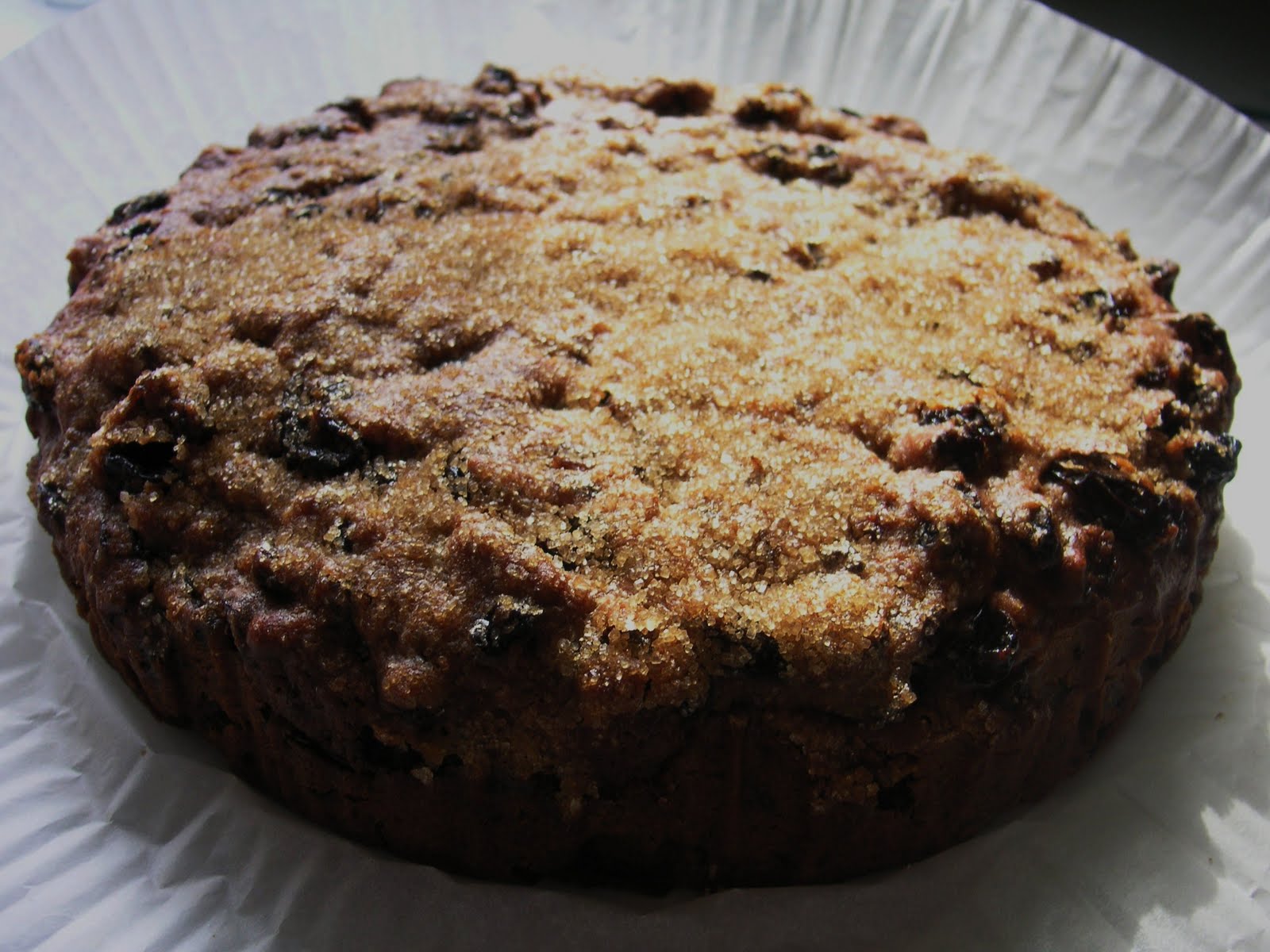
History corner – Buttermilk currant cake


This recipe comes courtesy of “The Currant Recipe Book”, published in 1945 by the wonderfully named Central Currant Office (London).
This makes me hope that there were regional Currant Offices scattered far and wide. There is little (practically none) online information about this organisation and I have so many unanswered questions: Was the Central Currant Office arch enemy of the Central Sultana Office and the Central Raisin Office? What happened to the CCO? Who is promoting currants now? Have currant sales fallen since there is no London office marketing them?


How can you fail to love a book where the introduction is titled “In praise of currants” and written by someone called Sir W. Arbuthnot Lane, President of the New Health Society? (His
Wikipedia write up is fascinating, showing him to be an admirably free thinker and some 40 years ahead of his time with his views on diet and digestive health). He notes that, because of the roughage they supply, currants are a “useful ‘regulating’ food”…..I think we all know what that means!


The CCO should actually have been named the Currant Propaganda Office for there are assertions made throughout the booklet; they form the headers and footers for each page and are presented as unquestionable facts.
While some are probably true or harmless enough, it does make you realise how unregulated food health claims were until fairly recently. Here are some of my favourites:

  • Eat more currants and forget “nerves”
  • Eat currants and work better
  • Currant bread tempts the appetite
  • Currants bring good health
  • Currants keep you fit
  • Children love currants – because they need them
  • Spare the currants and you spoil the cake
  • Currants make food tempting
  • You never get tired of currant bread
  • Currants give radiant vitality


My chosen recipe appears under the banner “currants correct acidity”.
At this point I was under such pro-currant enchantment that I’d have believed anything. This cake has lots of buttermilk, more buttermilk than I’ve ever seen in a recipe, but no eggs. It means that the cake is pale and you should test it’s ‘done-ness’ with a skewer rather than relying on it being golden.


The resulting cake was fruity with a hint of spice; it tasted very much like a good rock bun but with a light, soft, spongy texture.
Very pleasant indeed and a lovely tea time cake. It wasn’t as heavy as a full-on fruit cake, such as a Christmas cake, but had more oomph to it than a sponge. As to whether it improves ‘regulation’....I’ll keep you posted!


Ingredients

340g (3/4lb) plain flour
115g (1/4lb) unsalted butter
115g (1/4lb) caster sugar
170g (6oz) currants
Pinch of spice – I took this to mean mixed spice.
I added a teaspoon.
¾ teaspoon bicarbonate of soda
¾ teaspoon cream of tartar
440ml (3 gills) buttermilk

Optional (not in original recipe): 2 tablespoons Demerara to sprinkle on top of cake


Method

Preheat the oven to 170˚C/Fan oven 150˚C/325˚F/Gas Mark 3. The recipe says that the cake should be baked in a “steady oven” and I have interpreted it to mean these temperatures, based on other curranty/raisin cakes I’ve baked.

Line a 23cm round springform tin with baking paper. I played safe with tin size – you could get away with a 20cm tin but make sure that the baking paper comes up a good 2cm above the height of the tin.

Sieve the flour into a bowl and rub in the butter until the mixture resembles breadcrumbs. If you prefer, you can do this in a food processor.

Stir in the sugar, currants, spice and cream of tartar.

Dissolve the bicarbonate of soda in a little of the buttermilk then add to the mix, stirring well.

Stir in the remaining buttermilk.

Turn the mixture into the prepared tin and level the surface.

If using, sprinkle the Demerara over the top of the batter.

Bake for approximately 1 hour 10 minutes or until a skewer inserted into the middle of the cake comes out clean.

Stand the cake, in its tin, on a wire rack until the tin is cool enough to safely handle and remove.

Leave the cake to cool completely on the wire rack.

Bask in the glory of the wonderful thing you have made.

Eat.