Showing posts with label spice. Show all posts

Sunday, 8 November 2015

Oat and pear traybake with pecan crumble topping


I’m such a clichĂ© but the first whiff of winter and I’m cracking open the spice jars like nobody’s business!  I found the recipe for the oat sponge and crumble topping on a recipe sharing website and decided that it needed an extra element.  Oats, spice and pecans led me to the very easy decision to add some pear to the mix.  Pear is one of my absolute favourite fruits to bake with.


The pear is fruity and juicy and stops the sponge being too dry or heavy.  The nutty crumble topping adds texture and richness; the dark sugar seeps into the cak almost like a sauce.  I served the cake at room temperature with a cup of tea but it would work so well warm with ice cream or custard.  You could even bake it in individual pudding moulds for a fancy dessert (but reduce the cooking time accordingly).


Adding fruit to a batter always increases the wetness during baking so it’s worth draining the tinned fruit and patting it dry with kitchen paper.  I think that without the addition of the fruit the sponge may have been a bit dry; the juice was absorbed by the oats making an almost fragrant sponge – imagine an oaty bread pudding and you’re pretty close.  Have I mentioned how much I love baking with pears?


I suspect it won’t be an issue, but the cake keeps really well for several days.  The pear keeps the cake soft, and the nuts in the crumble topping improve with age (unlike the baker!).


I took a photo of a slice and went for my obligatory ‘fork shot’.  Then I went for another...and another....and it ended up like this:


NB.  The crumbs were left on the plate for artistic purposes and were polished off the moment I put the camera down!  Waste not, want not etc.......


Ingredients

For the cake:
100g porridge oats
330ml boiling water
115g unsalted butter, at room temperature
220g dark brown soft sugar
2 eggs
2 teaspoons vanilla extract
1 teaspoon cinnamon
1 teaspoon baking powder
½ teaspoon bicarbonate of soda
215g plain flour
1 tin diced pears – the tin was 410g with a drained weight of 225g

For the crumble:
100g dark brown soft sugar
10g plain flour
½ teaspoon cinnamon
½ teaspoon grated nutmeg
40g unsalted butter – cold
100g pecan nuts – roughly chopped


Method

Preheat the oven to 190C/ fan oven 170C/ 375F/ gas mark 5.

Grease a 30cm x 20cm traybake tin.

Cover the oats with the boiling water and put to one side.

Now make the crumble topping: Mix together the sugar, flour, cinnamon and nutmeg.

Rub in the butter until you have lumpy crumbs.
Stir in the chopped pecans.

Place in the fridge until needed; a cold crumble is always easier to scatter over the top as your hands won’t melt the butter as much.

Now return to making the cake: Beat the butter and sugar until soft and well combined – it will never go fluffy and whippy when you’re using dark sugar.

Beat in the eggs, vanilla and cinnamon.

Fold in the baking powder, bicarbonate of soda and plain flower.

If there is any, drain any unabsorbed liquid away from the oats and fold them into the mix.

Spoon the batter into the prepared tin. 

Drain the pears and pat them dry with some kitchen paper.

Scatter the diced pears over the batter and gently press down into the batter.

Sprinkle the chilled crumble over the top of the batter.

Bake for approximately 30-40 minutes or until a skewer inserted into the cake comes out clean.

Leave to cool in the tin before de-tinning and storing in an airtight container.

Bask in the glory of the wonderful thing you have created.

Eat.


Sunday, 1 November 2015

Chocolate orange carrot cake


I’ve never baked (or indeed seen, or eaten) a chocolate carrot cake before.  It seemed the perfect cake given the increasingly autumnal feel in the air – soft sponge with chocolate and spice; it would be a good Bonfire Night cake too.  Funny how we associate flavours with seasons/events.


Being a carrot cake this is a very light sponge.  The brown sugar adds a caramel sweetness which always works well with spice.  The cocoa adds a chocolately depth.  The sultanas are entirely optional but, in my world, always make everything better so I added some!  I ‘ummed and aaaaahed’ over whether to make this as a single sponge or to make as a sandwich style cake.  In truth, I think it would work as either, but I was in the mood for a little cream cheese frosting so whipped up an orange one to compliment the zest in the cake.


I like it when bakes evolve like this, with a series of little decisions being made along the way to create the finished item.  This was a very popular cake and something a little bit different which, 8 years into my blog, feels increasingly difficult to achieve!


The flavours of this cake work well together but all remain identifiable because they hit your palate at different times.  The initial hit is the chocolate sweetness; this is cleaned away by the sharp cream cheese frosting and you are left with a fruit orange spice flavour.  It comes in three distinct waves.  Once I spotted this I took my time over each mouthful (unlike me) and ticked the stages of flavour off each time...this is how I entertain myself!


Mr CC was very sceptical about this cake initially.  When I said to him I was making a chocolate orange carrot cake he gave me a look which I can only describe as a ‘what you talking bout Willis?’ look (a reference that you will need to be a certain age to get!) but, when he tasted it, he really liked it!


Ingredients

For the sponge:
280g soft light brown sugar
200g self raising flour
80g cocoa powder
½ teaspoon bicarbonate of soda
1 teaspoon mixed spice
1 teaspoon ground cinnamon
Optional: 50g sultanas
zest of 1 orange (save the rest of the orange for the buttercream)
4 eggs
200ml sunflower oil – or any flavourless oil, I used light olive oil suitable for baking
100ml milk
200g carrots, grated – this equates to approx 3 medium carrots

For the buttercream:
350g cream cheese – I used Philadelphia
50g unsalted butter, at room temperature
160g icing sugar
1 -2 tablespoons orange juice

To decorate: chocolate sprinkles


Method

Preheat the oven to 180C/fan oven 160C/350F/gas mark 4.

Line two 20cm loose bottomed round sandwich tins with baking paper.

Place all the dry ingredients in a bowl and mix together e.g. light brown sugar, self raising flour, cocoa, bicarb, mixed spice, cinnamon and – if using - sultanas.

Place all the wet ingredients in a large jug e.g. orange zest, eggs, oil, milk and carrots and beat together.

Pour the wet ingredients into the dry and mix together.

Divide equally between the cake pans.

Bake for approximately 40 minutes (start checking after 30 minutes) or until a skewer inserted into the cake comes out clean.

Leave to cool in the tins, on a wire rack, for about 30 minutes before turning out and leaving to cool completely.

Now make the filling: Beat the cream cheese and butter until soft, light and whippy.

Add the icing sugar and beat well.

Add the orange juice – start with just one tablespoon – and beat until you have a light, spreadable buttercream.  Add more orange juice if required.

Place one sponge on the serving plate and spread about 1/3 of the buttercream over the top.

Place the remaining sponge on top.

Cover the top and sides with the frosting.

Cover the top with chocolate sprinkles.

Refrigerate until about 20 minutes before serving.

Serve in generous slices with a cup of tea.

Bask in the glory of the wonderful thing you have created.


Eat.

Saturday, 22 August 2015

Spiced oat traybake


The mornings are staying darker longer, and we’re putting the lights on much earlier in the evening – if that doesn’t mean Autumn’s on its way then I don’t know what does!  I therefore take this as my trigger to start thinking about spices and oats and more substantial baking…in truth, my thoughts never leave such things but it’s nice to be a tiny bit seasonal if possible.


This traybake is simple to make and, next to fancier fare, could look a bit plain but that’s just how I like it.  There are very few decorated fancies that can hold a candle to something with raisins and oats in; they’re so wholesome and like eating a big hug.  If raisins aren’t your thing then replace with any other dried fruit, or be a complete maverick and use chocolate chips or even chopped ginger.  As long as you choose something dry, that won’t ooze during baking, the cake will work.


The smell of this baking will drive you wild.  I went for a cinnamon/mixed spice mix as I find cinnamon on its own can be overpoweringly dominant but, as with the fruit, mix it up to suit your tastebuds.


I think the oats and raisins mean you can get away with eating this for breakfast.  I do like a cake that is acceptable at any time of the day (ok, that’s all of them in my world, but I do try and fit in with ‘normal’ views…or at least pretend to!).  Now, you might think this photo is blurry, but I prefer to think of it as ‘how Monet would’ve viewed the cake’:


The final thing it is my duty to point out(!) is that the texture of this cake is lighter than sponge.  I know, I know, you see ‘oats’ in the title of a bake and it’s impossible not to think of flapjacks and that heavy, dense texture.  But this cake is a million miles away from that; it is unbelievably light and airy...and I say that as someone who has done their research*.

*Research = eaten three pieces in one sitting.


Ingredients

300ml boiling water
80g porridge oats
110g unsalted butter, at room temperature
150g dark brown soft sugar
125g caster sugar,  plus an extra 2 tablespoons to sprinkle on top
2 eggs
1 teaspoon vanilla extract
1 teaspoon bicarbonate of soda
pinch of salt
½ teaspoon ground cinnamon
½ teaspoon mixed spice
200g plain flour
70g raisins


Method

Pour the boiling water over the oats and leave to stand for 20 minutes.

Preheat the oven to 180C/fan oven 160C/350F/gas mark 4.

Grease a 30cm x 20cm traybake tin. (I recommend greasing or using non stick foil as this is a sticky sponge and it didn’t seem to get on well with the baking paper I stood it on to cool after baking).

Beat together the butter and both sugars until well combined – it will never go light and whippy with dark sugar.

Beat in the eggs one at a time.

Stir in the oats and vanilla, mixing well to ensure all the ingredients are combined.

In a separate bowl combine the dry ingredients i.e. bicarbonate of soda, salt, cinnamon, mixed spice and flour.

Stir the raisins into the dry mix – this will coat them and stop them clumping in the batter.

Add the dry ingredients to the oat mixture and stir well enough to combine all the ingredients.

Spoon into the prepared tin and level the surface.

Sprinkle over the extra caster sugar.

Bake for approximately 30-40 minutes or until a skewer inserted into the mix comes out clean.

Leave to cool, in the tin, on a wire rack.

Serve in generous slices with a mug of tea.

Bask in the glory of the wonderful thing you have created.


Eat.

Sunday, 18 January 2015

Brown butter spice cake


Christmas may be over but winter is definitely here, which is why I was drawn to a spicy cake this week.  This cake had so many lovely facets that appealed to me: tea, spice, treacle, brown butter and even a bit of citrus.  All the flavours were offset by a very simple classic buttercream.


It’s worth taking your time over making the brown butter.  Your nose will tell you without any doubt that there is a huge difference between brown butter and burnt butter!  Gently heat the butter and it will become foamy; let this stage pass and the butter will turn clear and a wonderful dark amber colour…and it smells divine.  It’s also a bit like caramel in that you’re better to take it off the hob just before it’s at the stage you want, as it carries on darkening and you risk taking it too far.


This is such a comforting, homely looking cake but it packs in so much flavour – the best of all worlds.  The tea and citrus lifts what would otherwise be a lovely but ordinary dense gingerbread; I expected the cake to be more sponge-like but it isn’t – it’s definitely in the gingerbread camp.    Not sure what I did but my cakes came out huge!  I had to shave a bit off each one just to get it to a size that would fit in any of my storage tins!  Still, it gave me the opportunity to photograph a whole layer:


This cake is a keeper, by which I mean you’re best off making it a day or two in advance – it gets stickier and more flavoursome.  Bring on the snow – I’m ready for it!


Ingredients

For the cake:
250g unsalted butter
250g caster sugar
2 eggs
100g treacle
250ml tea, made using 2 teabags
Grated zest of 1 orange
600g self raising flour
1 teaspoon ground cinnamon
½ teaspoon ground ginger
½ teaspoon mixed spice

For the buttercream:
100g unsalted butter, at room temperature
1 teaspoon vanilla extract
200g icing sugar
1 tablespoon milk


Method


Preheat the oven to 180C/fan160C/350F/ gas 4. 
Line two loose bottomed 20cm round sandwich tins with baking paper.
Now make the cakes: melt the butter in a pan until it turns brown (but not burned).  Do this over a gentle heat – at first it will foam, but will brown shortly after.
Strain the butter through a coffee filter or several sheets of kitchen paper into a bowl and leave to cool.
Beat the cooled brown butter into the sugar, eggs and treacle.
Stir in the cooled tea and orange zest (I put the zest in the tea so that it infused the flavour into the tea).
In a separate bowl mix together the flour, spices and baking powder.
Beat the butter mixture into the flour mixture.
Divide evenly between the prepared tins and level the surfaces.
Bake for 20-25 minutes or until a skewer comes out clean.   Mine actually took a fair bit longer – nearer to 40 minutes.
Cool, in their tins, for 20 minutes before de-tinning and leaving to cool completely on a wire rack.
Now make the buttercream: beat the butter until it is soft and whippy.
Beat in the vanilla and icing sugar.
Beat in the water.
Place one of the cakes on the serving plate and spread the buttercream over it.
Place the other sponge on top.
Bask in the glory of the wonderful thing you have created.
Eat.


Sunday, 16 November 2014

Tea loaf cake


Classics become classics for a reason – usually because they’re great.  There is something about a tea loaf cake that is inherently nostalgic.  I feel it has always been in my life and I can clearly remember, from a young age, the smell of it being toasted and buttered to have with a cup of tea on Sunday afternoons.  Back then I wasn’t a fan of it being toasted but I like it now.


I enjoy making any recipe where soaking of fruit is involved, be it an alcoholic bath for Christmas cake fruits or – as in this instance – tea.  Each time I pass the bowl I cannot resist tinkering with it; carefully mixing the fruit to ensure each sultana and raisin gets a chance to soak and absorb the flavours.  What is unusual in this recipe is that you add the sugar at this stage too – I’d not seen that before.  The only thing to be aware of with this recipe is the soak time i.e. you need to start it a day before you wish to make it.  Other than that, it’s a doddle!


When you spoon the cake into the tin it will seem like the mix is all fruit and no cake.  That’s often the way with these sort of bakes but don’t worry, the magic of the oven will sort it all out and I promise you’ll end up with a lovely tea loaf!  Mine seems to have come out huge (even by my standards) – not sure why!


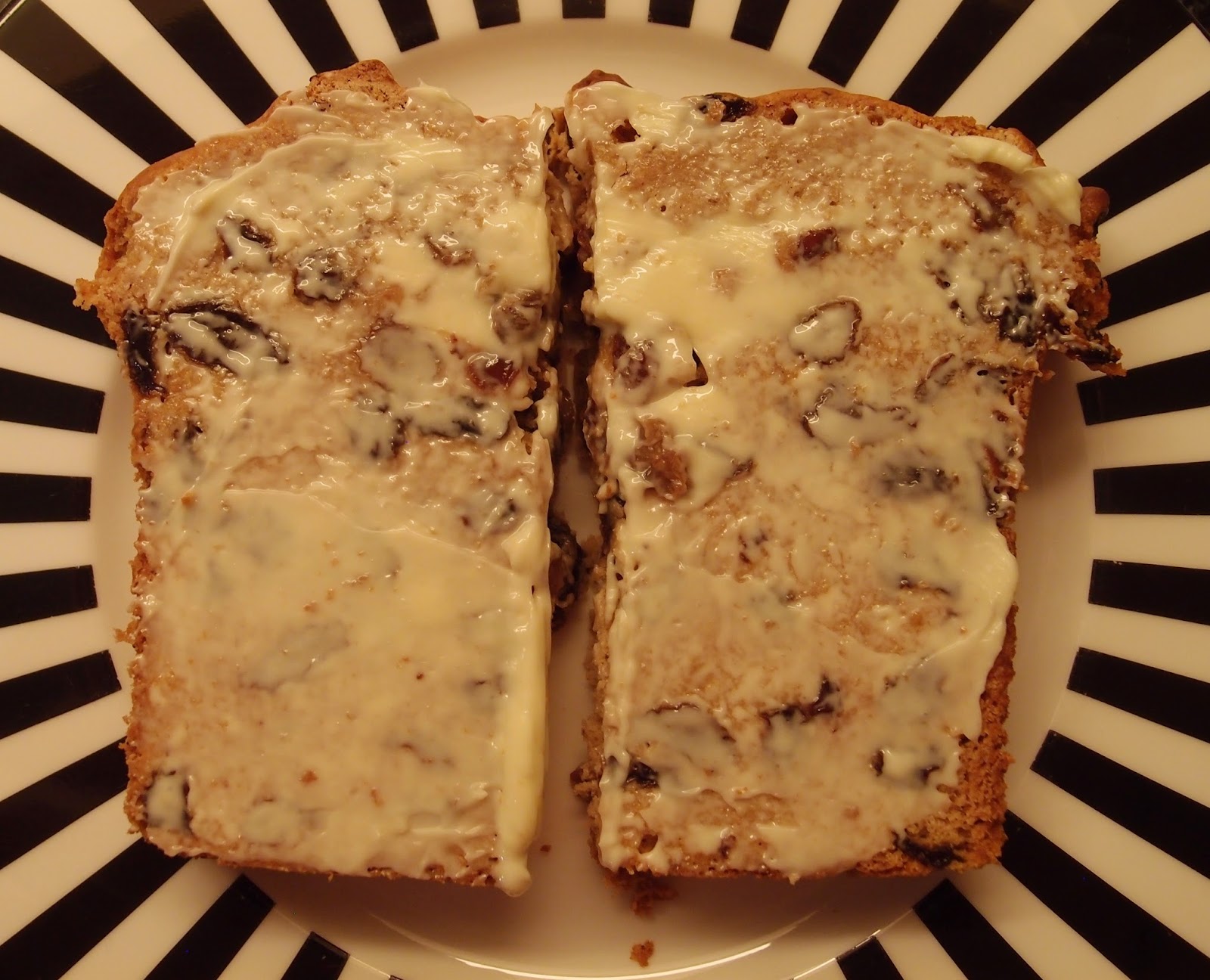
If you’ve read my blog for any length of time you will know my only rule for buttering a slice of fruit loaf: the butter has to be thick enough that you leave teeth marks in it when you take a bite.  If your dentist couldn’t identify you from the impression you have left in the slice of fruit loaf then you need to reconsider your approach to buttering. 


Ingredients

250g sultanas
250g raisins
250g caster sugar
375ml cold tea – any tea you like!
1 egg
500g self raising flour
1 teaspoon mixed spice
1 teaspoon grated nutmeg


Method

The day before baking place the sultanas, raisins, caster sugar and cold tea in a bowl and mix together. 

Cover the bow and leave to stand overnight.  Stir occasionally.

Preheat the oven to 180C/fan oven 160C/350F/gas mark 4.

Line a 900g loaf tin with baking paper.

Beat the egg and then stir into the bowl of soaked fruit.

Add the flour and spices to the fruit mix and stir well to ensure that everything is well combined and there are no clumps of flour.

Spoon into the prepared tin and level the surface.

Bake for approximately 1 hour or until a skewer inserted into the loaf comes out clean.

Leave to cool in the tin for 15 minutes before de-tinning and leaving to cool completely on a wire rack.

Serve in slices with thick butter.  As the loaf ages it is delicious to toast.

Bask in the glory of the wonderful thing you have created.


Eat.

Sunday, 22 June 2014

Speculaas biscuits


Anyone who has been to the Netherlands is bound to have either eaten, or brought back and eaten, or brought back as gifts (and then hopefully eaten when visiting) Speculaas biscuits.  I have enjoyed them thin and crispy, and also thicker and more gingerbread-like in texture.  The warming combination of spice is lovely and, while they are traditionally a Christmas biscuit, I see no harm in enjoying them all year round.


What has stopped me making speculaas thus far is the absence of an authentic spice mix, or recipe to make one.  Therefore when Steven Dotsch, of the Speculaas Spice Company kindly offered to send me a sample of their speculaas spice mix I typed, ‘yes please’ as fast as my biscuit-loving hands could manage!  Opening the sachet released a heavenly waft of warming spices and I sat there sniffing, turning away to let the smell disappear, and then turning back and inhaling again.  I would have carried on doing this a lot longer had I not become aware of Mr CC watching me with a puzzled expression.


There seems to be a wide variety of speculaas biscuit recipes out there; I did some window shopping and then chose which elements to include in my version.  I opted for ground almonds and orange zest because I planned to make the thicker, more gingerbread-like textured biscuit and both ingredients released oils that would stop the dough from being too dry or bready.  The orange was the first flavor to hit followed by the warming spices; I particularly liked the texture of these biscuits as they were light and crisp.  Here they are ready for the oven:


Freshly baked:


I love this photo – you can see the dark flecks of spice in the biscuit:


The smell of these baking was the smell of Christmas!  I was tempted to break out my Michael Buble Christmas CD until I remembered it was June and I didn’t need to give Mr CC any more reasons to doubt my sanity. (As a side note, I suspect the mere fact that I own Michael Buble CDs is enough to make Mr CC doubt my sanity…let’s just say he’s not a fan! Of Mr Buble, that is.  I know he likes me!)


Ingredients

For the biscuit dough:
250g self raising flour
125g soft brown sugar
3 teaspoons speculaas spice mix
50g ground almonds
1 orange – zest only
100g unsalted butter, at room temperature
1 egg
1 tablespoon milk


For the glaze:
1 egg white, beaten
3 teaspoons soft brown sugar
Handful of flaked almonds 


Method

Preheat the oven to 180°C/ fan oven 160°C/350°F/ gas mark 4


Line two baking sheets with baking paper or non stick foil.


Place all the biscuit dough ingredients in a mixer or food processor and blitz together until you have a ball of dough. 


Shape into a fat disc and wrap in clingfilm.


Refrigerate for about 30 minutes.


Roll the dough out between two sheets of clingfilm – this stops you needing to add extra flour to the dough.  Aim for just under 0.5cm thickness. 


Using the cutter of your choice cut your biscuits out and place on the baking sheet – they spread a little but not much.  I used a 7cm round cutter and got 22 biscuits.


Reroll the dough to ensure it is all used – it rerolls very well so you should be able to use every last scrap.


Brush with the egg white and then sprinkle on the soft brown sugar.

Arrange the flaked almonds on the top of each biscuit.

Bake for approximately 14 – 18 minutes or until the biscuits are turning brown.  I like to rotate my baking sheets halfway through the cooking time to encourage even browning.


Leave to cool on the baking sheet for 10 minutes before removing and placing on a wire rack to cool completely.


Bask in the glory of the wonderful thing you have created.


Eat.

Sunday, 10 November 2013

Sultana spice cake with quince curd – and Movember news


There is something about quince that I find appealing.  The last time I tried to describe it I ended up calling it a pregnant apple  and I still think that stands.  It’s almost a hybrid – the offspring of an apple and pear.  It has a gentle fragrance and a softly gritty texture (like a pear).


The one thing about quince that puts me off using it is how hard it is to chop.  But not this time!  I was very kindly gifted a knife sharpener by the nice people at Handpicked Collection 
and I decided to test it out with this task.  All I can say is – wow!  I leant on the knife expecting it to be a struggle to get through the, frankly massive, quince and almost lost my balance as the knife sliced through it without any strain.


I adapted the cake from one of my favourite recipes
 using brown sugar and mixed spice.  It really is a cracking cake and would be a good last minute Christmas cake if you want something lighter than the traditional fare.  It keeps like a dream too.


At the last minute I changed my mind about using the curd to sandwich the cake.  The reason for this was that it would’ve meant the whole cake needed refrigeration and I wasn’t sure the cake would keep well like that.  I served it on the side, as you would cream, but it would also be nice to spread it on the cake like butter.


Now, the observant among you will have noticed it’s November...or Movember as it’s known in Caked Crusader Mansions.  Mr CC has manned up again and is currently sporting a fairly sparse collection of whiskers that will shortly amount to a fine ‘tache...we hope!  If you wish to donate to a fabulous cause (fighting prostate and other male cancers) please visit Mr CC’s Mo spacePlease leave your name (or blogger name if you prefer) and I will enter you into my prize draw to win this:


Yes!  A totally awesome Nordicware bundt tin.  Because it’s such a good cause I will send the tin anywhere in the world so please don’t feel you can’t join in if you’re outside the UK; last year’s prize went to Poland.  I will draw the winner at the end of November.  Every donation helps, and justifies Mr CC sporting a bandito through my and his mother’s birthday party photos every year!  Thanks for any donation you can make.


Ingredients:

For the cake:
250g unsalted butter, at room temperature
125g golden caster sugar
125g light brown sugar

3 eggs, beaten
2 teaspoons mixed spice
320g sultanas
375g plain flour
1.5 teaspoons baking powder
170ml buttermilk

For the quince curd:
400g quince – peeled, cored and chopped.  400g is the prepared weight.  This will amount to one huge, or 2-3 normal quinces
65g lemon juice – I needed 2 lemons
125g caster sugar
4 eggs
75g unsalted butter – straight from the fridge


How to make:

Preheat the oven to 160°C/fan oven 140°C/315°F/Gas mark 2-3.
Line a 23cm round springform tin with baking paper.  Make sure the paper comes up above the height of the tin.

Cream the butter and sugar until light and fluffy. This is a big cake that uses large quantities of ingredients so it will take longer to cream the butter and sugar. Don’t skimp!

Gradually beat in the egg and mixed spice. If the mix looks like it’s curdling add some of the flour.

Stir in the sultanas.

Fold in a third of the flour and baking powder, then a third of the buttermilk, then a third of the flour and so on until both are fully combined.

Spoon into the prepared tin and level the surface.

Bake for 1 - 1 ¼ hours or until a skewer comes out cleanly. Mine took 1 hour 5 minutes.  Cool for 30 minutes before removing from the tin and allowing to cool completely on a wire rack.


While the cake is baking and cooling you can make the curd: place the chopped quince in a saucepan and cover with cold water.

Bring to the boil then simmer until the quince is soft – mine took about 40 minutes, but as all fruits will be different I’d start checking it after 20 minutes.

Drain the quince and puree, while still warm, to a pulp.

Place the pureed quince into a glass or metal bowl and rest the bowl over a pan of simmering water, taking care that the water doesn’t touch the bowl.

In a separate bowl beat together the lemon juice, caster sugar and eggs.  You only need to beat until they are combined – you’re not looking to add volume to the mix.

Pour the egg mix into the quince and cook – stirring very regularly – until the mixture thickens.  This may take 20 minutes or more.

Once cooked, remove from the heat and stir in the cold butter.  This will make the curd shiny.

There is no harm in passing the curd through a sieve at this stage - just in case there are any eggy bits.

Leave to cool before refrigerating.

Up to this point, the cake can be made a day in advance of serving.

Assemble the cake when you’re ready to serve it: either slice the cake through into two or three layers and then sandwich with the curd, or cut slices and spread the curd on as if buttering it.  I decided to serve it on the side, like you would whipped cream.

Bask in glory at the wonderful thing you have made.

Eat.