Showing posts with label loaf cake. Show all posts

Sunday, 12 June 2016

Ginger and rum cake


I think I must be a contrarian baker.  Now that summer actually seems to have arrived, I know I should be thinking about strawberries, cream and other such light frippery….but what I really wanted this week was ginger cake.  And rum.  And dates.  And all things that make you think of colder weather (not that I even like colder weather).  As I said – contrarian.


This cake is always better the day after baking, and the day after that; it’s always the way with sticky spicy cakes – they need time to mellow and let their flavours mature.  I do have a penchant for rum and have a selection at home that would rival most cocktail bars; for this cake I chose a spiced rum as I thought the extra punch of flavour would work well.  Spiced rum always seems to have a vanilla note to it too and I never miss the opportunity to get a bit of vanilla into something.


You can taste each of the main flavours in the cake: ginger, dates and rum.  Putting the rum in the icing gives a raw hit – if you like your booze softer, and more baked, consider putting more in the cake and leaving it out of the icing.


Without checking through almost nine years of blogging, I don’t remember putting dates into a ginger cake before.  It was a good move – it turned a standard ginger cake into something more akin to a sticky toffee pudding.  You could leave the icing off this cake and serve it warm, as dessert, with custard or ice cream.  Personally, I am always partial to a white icing and a bit of the itchy teeth feel it can sometimes create.  Many older people I know have lost their taste for overly sweet things…I do sometimes wonder if it will ever happen to me.  I just can’t imagine being that person who winces when they eat something and say, ‘ooh, that’s a bit sweet for me’.  Does. Not.  Compute.


Ingredients

75g unsalted butter
100g dark muscovado sugar
125g black treacle
125g golden syrup
2 eggs
3 tablespoons rum – I used spiced rum
225g self raising flour
2 teaspoons ground ginger
50g stem ginger, finely chopped
75g medjool dates – pitted and finely chopped
For the icing:
100g icing sugar
1-2 tablespoons spiced rum
1 tablespoon stem ginger syrup (from the jar of stem ginger)

Method

Preheat the oven to 180C/fan 160C/350F/gas mark 4.

Line a 900g loaf tin with baking paper.

Place the butter, sugar, treacle and golden syrup into a saucepan and melt together over a gentle heat.

Leave to cool for at least 5 minutes before beating in the eggs and rum – if the mix is too hot the eggs will scramble and leave lumps in the cake.  Not nice.

Stir in the flour and ground ginger.

Stir in the chopped ginger and dates.

Pour into the prepared baking tin.

Bake for 50 minutes – 1 hour, or until a skewer inserted into the cake comes out clean.

Leave to cool for 10-15 minutes in the tin, before de-tinning and leaving to cool completely on a wire rack.

Now make the icing: mix the icing sugar with 1 tablepsoon each of rum and ginger syrup – add the extra spoonful of rum only if needed.  You’re aiming for a thick, glossy icing that has movement to it but isn’t so loose it will just run off the cake.

Spoon the icing over the cake and leave to set.

This cake gets better with age – it becomes stickier and more flavoursome.

Serve in generous slices with a cup of tea.

Bask in the glory of the wonderful thing you have created.

Eat.


Sunday, 17 April 2016

Fruit tea loaf


This recipe came into being because I made a whim purchase.  Whilst visiting a Greek Cypriot supermarket on the quest for baklava (as instructed by Mr CC; if only all quests in life were this tasty!), I spotted a pouch of dried red and white mulberries.  I was starting from a position of ignorance: I didn’t know anyone other than silk worms ate mulberries, but, seeing as I didn’t see any silk worms doing their shopping I deduced that they must also be human food.


What caught my attention was their beautiful knobbly appearance.  I want to describe them as looking like a raisin that had suffered a severe allergic reaction to something but this wouldn’t convey how cute they are.  Texturally, they are similar to a dried fig i.e. they have a bit of grittiness about them.  They are also very dry, which was why I decided to use them in a tea loaf, where they’d have the opportunity to plump and rehydrate.


Having read up about mulberries they seem to be considered a superfood.  I always struggle with this term as – to me – most food is pretty darned super, but it is because they’re high in protein, iron and vitamins blah blah science etc.  They taste nice too – which is the most important thing; imagine a less sweet sultana.


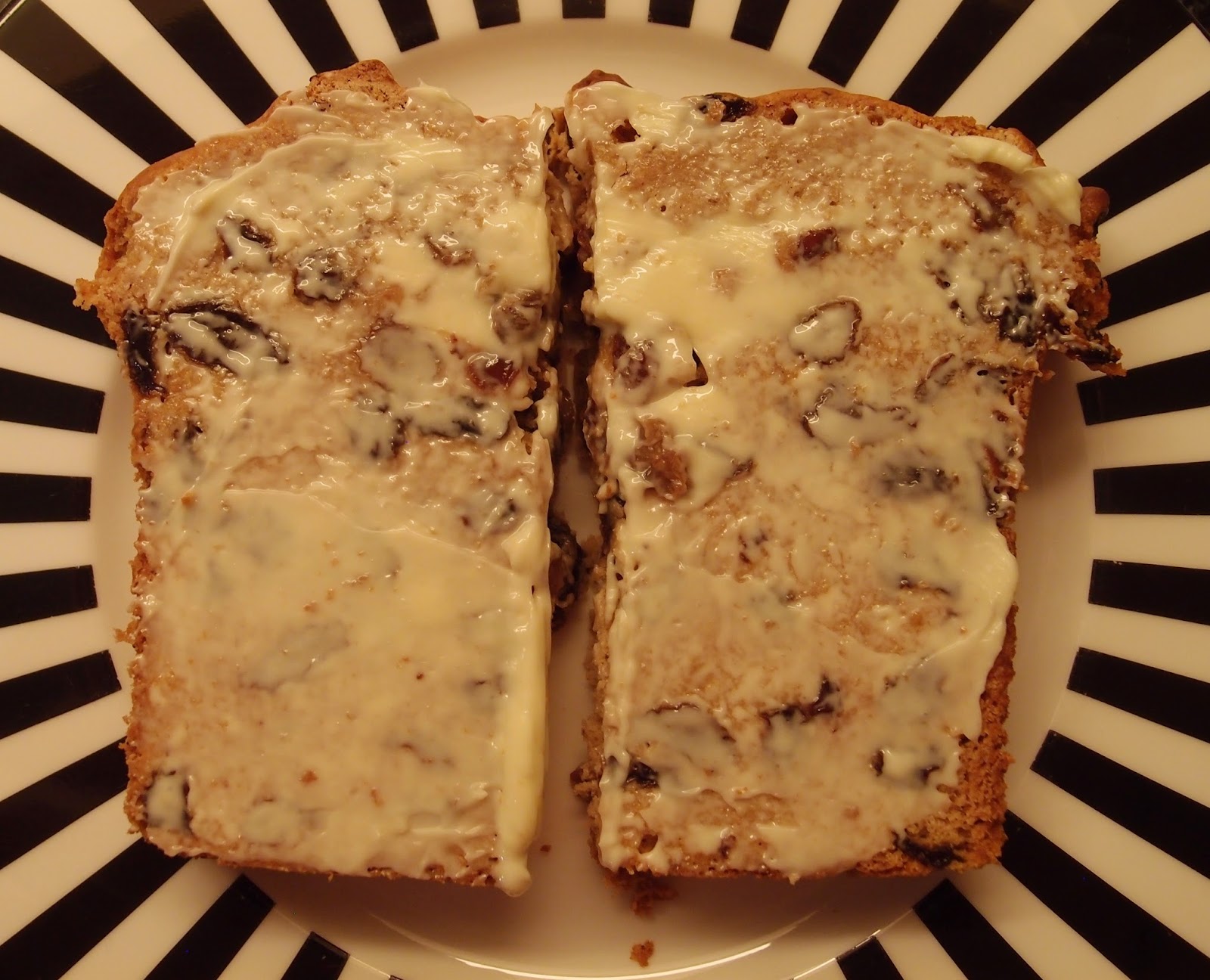
Thickly buttered fruit loaf is one of life’s great joys.  I always say that you can toast the loaf and then butter it, but I never have any left to get to do that!


Ingredients

340g dried fruit – I used dried mulberries and sultanas
60g glace cherries – chopped
110g dark brown soft sugar
200ml cold tea – I used 2 teabags to boost the flavour
225g self raising flour
1 egg


Method

The night before you wish to bake the cake: place the fruit, cherries and sugar in a bowl and mix with the tea.  Cover the bowl and leave - ideally overnight but longer won't hurt.

Day of baking: Preheat the oven to 190C/fan oven 170C/375F/gas mark 5.

Line a 900g loaf tin with baking paper.

Mix the flour and egg into the pre-soaked fruit mix – ensure it is well combined and no pockets of dry flour or egg remain.

Spoon into the prepared tin and level the surface.

Bake for approximately 1 hour or until a skewer inserted into the cake comes out clean.  If the cake is browning too quickly, don’t be afraid to cover it loosely with foil.

Leave to cool on a wire rack.

Serve in slices with butter thick enough to leave teeth marks when you bite into it!

Bask in the glory of the wonderful thing you have created.


Eat.

Sunday, 21 February 2016

Famous faces' favourite fancies – Gin and lemon drizzle cake


I was sad to read about the recent death of Sir Terry Wogan as he was one of those national treasure celebrities who was just part of your life without you ever realising it.  From loving his hilarious, disrespectful commentary of the Eurovision Song Contest (being allowed to stay up late for this was a treat in itself) to watching his face fall when Kenny Everett broke his funny stick microphone in Blankety Blank, if you were a child of the 70s and 80s he was part of the scenery.


His early evening chat show in the 80s and early 90s was one of the few shows to see bands perform their new singles and who can forget that incredible David Icke interview ?(shockingly this was 1991 - 25 years ago!!!! I've never felt so old!)  His charm, wit and refusal to take himself seriously was totally endearing and why people loved him; it takes a lot of talent to make everything seem so effortless.


Sadly, I didn’t make his request during his life time but felt it right to make it in tribute to him, and all the entertainment he provided us with. I can’t make his actual request – Lady Wogan’s lemon drizzle cake – but I decided to make something a little out of the ordinary and added a measure of gin to the lemon drizzle mix.  Sort of my way of toasting the inimitable Sir Terry!


The addition of the gin added a lovely extra element to the cake – it gave an almost sherbet-like zing to the drizzle.  I never used to like gin but have found that I now rather like the less perfumed versions, and Tanqueray is my favourite.  If you’re looking for a new way to enjoy a gin and lemon, this might just be it!


Ingredients

For the cake:
175g unsalted butter, at room temperature
175g golden caster sugar
2 eggs
175g self raising flour
1 lemon, zest and juice

For the drizzle:
50g golden caster sugar
1 lemon, zest and juice
25ml gin – I used Tanqueray


Method

Preheat the oven to 180C/fan oven 160C/350F/gas mark 4.

Line a 900g (2lb) loaf tin with baking paper.

Beat together the butter and sugar until smooth and whippy.

Beat in the eggs one at a time.

Fold in the flour.

Fold in the lemon zest and juice.

Spoon into the loaf tin and level the surface.

Bake for approximately 40 minutes or until a skewer inserted into the cake comes out clean.

While the cake is baking, stir together the sugar, zest, lemon juice and gin to make the drizzle.

As soon as the cake is baked – and while it is still in the tin – pierce the sponge with a skewer before brushing the drizzle mixture over the top of the cake.

Leave to cool.  I leave it in the tin so the drizzle has to be absorbed and can’t ooze out anywhere.

Serve in generous slices.

Bask in the glory of the wonderful thing you have created.


Eat.

Sunday, 16 November 2014

Tea loaf cake


Classics become classics for a reason – usually because they’re great.  There is something about a tea loaf cake that is inherently nostalgic.  I feel it has always been in my life and I can clearly remember, from a young age, the smell of it being toasted and buttered to have with a cup of tea on Sunday afternoons.  Back then I wasn’t a fan of it being toasted but I like it now.


I enjoy making any recipe where soaking of fruit is involved, be it an alcoholic bath for Christmas cake fruits or – as in this instance – tea.  Each time I pass the bowl I cannot resist tinkering with it; carefully mixing the fruit to ensure each sultana and raisin gets a chance to soak and absorb the flavours.  What is unusual in this recipe is that you add the sugar at this stage too – I’d not seen that before.  The only thing to be aware of with this recipe is the soak time i.e. you need to start it a day before you wish to make it.  Other than that, it’s a doddle!


When you spoon the cake into the tin it will seem like the mix is all fruit and no cake.  That’s often the way with these sort of bakes but don’t worry, the magic of the oven will sort it all out and I promise you’ll end up with a lovely tea loaf!  Mine seems to have come out huge (even by my standards) – not sure why!


If you’ve read my blog for any length of time you will know my only rule for buttering a slice of fruit loaf: the butter has to be thick enough that you leave teeth marks in it when you take a bite.  If your dentist couldn’t identify you from the impression you have left in the slice of fruit loaf then you need to reconsider your approach to buttering. 


Ingredients

250g sultanas
250g raisins
250g caster sugar
375ml cold tea – any tea you like!
1 egg
500g self raising flour
1 teaspoon mixed spice
1 teaspoon grated nutmeg


Method

The day before baking place the sultanas, raisins, caster sugar and cold tea in a bowl and mix together. 

Cover the bow and leave to stand overnight.  Stir occasionally.

Preheat the oven to 180C/fan oven 160C/350F/gas mark 4.

Line a 900g loaf tin with baking paper.

Beat the egg and then stir into the bowl of soaked fruit.

Add the flour and spices to the fruit mix and stir well to ensure that everything is well combined and there are no clumps of flour.

Spoon into the prepared tin and level the surface.

Bake for approximately 1 hour or until a skewer inserted into the loaf comes out clean.

Leave to cool in the tin for 15 minutes before de-tinning and leaving to cool completely on a wire rack.

Serve in slices with thick butter.  As the loaf ages it is delicious to toast.

Bask in the glory of the wonderful thing you have created.


Eat.

Sunday, 21 September 2014

Orange madeira cake


There is something about the juicy flavour of orange that lifts a sponge and elevates it to something far beyond the sum of its parts, and yet I find that I don’t bake with it very often.  This is a conundrum.  To rectify this I found a madeira cake recipe that used lemon and switched it to orange, also adding an orange glaze.


Loaf cakes are very satisfying for a blogger – they are usually quick and easy to get into the oven, and you’re guaranteed nice even slices to photograph!  The shape of the tin provides a nice crust and a soft sponge underneath…no wonder they are Mr CC’s favourite (as a side note I am pleased to report that, while he doesn’t really understand why, he has learned that ‘dry’ is not taken as a compliment when critiquing sponge!)


This cake smells glorious while baking in the oven; it is a cake to bake while you have people looking around your home thinking of buying it!  The addition of a small amount of ground almonds also keeps the cake moist and gives it a lovely crumb.


Using freshly squeezed orange juice in the glace icing pays dividends; it’s almost confusing in your mouth because you’re eating icing but tasting orange juice – it really packs a punch in terms of flavour.


Ingredients

For the sponge:
175g unsalted butter, at room temperature
175g golden caster sugar
3 eggs
grated zest of 1 orange
200g self raising flour
50g ground almonds

For the glaze:
100g icing sugar
enough orange juice to make an icing – add 1 teaspoon at a time


Method

Preheat the oven to 170°C/fan oven 150°C/340°F/gas mark 3.

Line a 900g loaf tin with baking paper.

Beat together the butter and sugar until light and whippy – don’t skimp on this stage.

Beat in the eggs one at a time, adding some of the flour if it looks like the mix might curdle (NB. Use this as a test – if you’ve beaten your butter and sugar enough it won’t curdle!)

Fold in the orange zest, flour and ground almonds.

Spoon into the prepared tin and level the surface.

Bake for approximately 55 minutes or until a skewer inserted into the cake comes out clean.

Leave to cool, in the tin, for approximately 20 minutes before de-tinning and leaving to cool completely on a wire rack.

When the cake is cold you can make the icing: beat together the icing sugar and orange juice until you have a thick glossy glaze.  Add the orange juice 1 teaspoon at a time – it is very easy to make it too runny.

Spoon over the cake and let drizzle down the sides.

Serve in thick slices with a cup of tea.

Bask in the glory of the wonderful thing you have created.

Eat.


Sunday, 6 July 2014

Coconut and lime loaf


I knew this weekend was going to be a little unpredictable with lots of comings and goings (not to mention one of the greatest Wimbledon finals of all time...sorry for the late posting of this!) so I wouldn’t get my normal, nice, calm baking time.  However, I did still want some homemade cake – obviously!  This recipe is a perfect one to have up your sleeve at such times:  minutes to get in the oven, delicious, and perfect for summer with its tropical flavours.


Coconut and lime is a combination I can be funny about, particularly if the lime is too dominant.  I like the lime in the background to lift the coconut, not as a strong acidic flavour.  To achieve this I used the zest in the sponge, and the juice in the icing.  If you’re a little more hardcore where lime is concerned, add the juice of an additional lime to the cake mix.


Using condensed milk in the cake produces a dense, moist crumb reminiscent of a yoghurt-based sponge.  Condensed milk is very sweet so the recipe does not use any other sugar in the sponge – it really doesn’t need it! 


Next time I make this I might ‘up’ the tropical element and add some Malibu to the batter; it could also be used instead of the lime juice in the icing, although that little kick of zing in the glace icing was one of my favourite elements.  My only regret is that I didn’t have a little cocktail umbrella to decorate the cake with!


Ingredients

For the sponge:
175g unsalted butter, at room temperature
3 eggs
250g condensed milk
80g desiccated coconut
Optional: 1 teaspoon coconut extract
Grated zest of 2 limes – if you want a stronger hit of lime in the cake use the juice of one lime too
175g self raising flour
1 teaspoon baking powder

For the icing:
100g icing sugar
Juice of 1 lime
2 tablespoons desiccated coconut

Optional decoration: lime zest or coconut shavings (or both!)


Method

Preheat the oven to 170°C/ fan oven 150°C/ 340°F/ gas mark 3.

Line a 900g loaf tin with baking paper.

Beat the butter until it is light and whippy.

Add all the remaining sponge ingredients and beat until pale and creamy looking.

Pour (the batter will be runny) into the prepared tin and bake for approximately 1 hour or until a skewer inserted into the sponge comes out clean.

Check the cake after 55 minutes and, if it is browning too quickly, cover the tin lightly with foil.

Leave to cool in the tin for 20 minutes before turning out onto a wire rack and leaving to cool completely.

Now make the icing: beat together the icing sugar and enough of the lime juice to make a thick, glossy icing.  Add the lime juice 1 teaspoon at a time as it doesn’t take much to make the icing too thin – you might not need the whole lime.

Drizzle the icing over the cake.

Scatter over the coconut shavings or lime zest and leave to set.

Bask in the glory of the wonderful thing you have created.


Eat.

Sunday, 2 March 2014

Famous Faces’ Favourite Fancies - Genoa cake


Can you believe the last ‘Famous Faces’ post was April 2013?  Why have I left it so long?  I have no answer to that as I do have a stash of them to post.  For those of you (all of you I’d imagine, given my tardiness!) who’ve forgotten what this is all about, basically I wrote to a bunch of celebrities I liked and asked them to tell me their favourite cake.  Which I then bake and post the recipe for.


I thought I’d kick start my Famous Faces posts with a national treasure – June Whitfield.  Hard though it is to believe, June started her career on the radio in the 1940s!  To me, she’s one of those utterly timeless people who never appears to age.  I remember her in my childhood from TV shows such as ‘Terry & June’ but perhaps my favourite role of hers, and I suspect the one most known to non-UK readers of my site, was as Edina’s mother in ‘Absolutely Fabulous’ where her seemingly innocent yet withering put downs were delivered with brilliant ease.


June has selected Genoa cake although she caveats that with ‘not too often’.  Maybe we’ll have to politely disagree on that one....!


Genoa cake is a British classic and is based on
the Pandolce cake which originated in 16th century Genoa as a Christmas cake. It’s lighter than a traditional Christmas heavy fruitcake (think more the texture of a tea loaf) and has no icing.  The top is decorated with cherries and almonds. It seems, based on all the pictures I’ve seen, to be more commonly baked in a loaf tin rather than a round tin.  I have no problem with that – it is so much easier to cut a loaf cake!


Ingredients

115g unsalted butter, at room temperature
75g light brown sugar
2 eggs
225g dried fruit – I used a mix of sultanas, raisins and currants
75g glace cherries, chopped in half
Grated rind of 1 orange
1 teaspoon ground cinnamon
175g plain flour
1 ½ teaspoons baking powder
50g ground almonds
50ml milk

To decorate:
Handful of glace cherries chopped in half
Handful of whole almonds


Method

Preheat the oven to 180°C/ fan oven 160°C/ 350°F/ gas mark 4.

Line a 900g (2lb) loaf tin with baking paper.

Beat together the butter and sugar until light and creamy.  You will notice the mix turns paler – always a good sign you’ve beaten it enough!

Beat in the eggs, one at a time.

Add the fruit, cherries, orange rind, cinnamon, flour, baking powder, almonds and milk and stir well to ensure all the ingredients have been incorporated evenly.

Spoon into the prepared tin and level the surface.

Gently press the decorate cherry halves and almonds into the top of the cake.

Bake for approximately 1 hour, but don’t worry if it needs longer, or until a skewer inserted into the cake comes out clean.

Leave to cool in the tin for 30 minutes before de-tinning and leaving to cool completely on a wire rack.

Serve in generous slices with a cup of tea.

Bask in the glory of the wonderful thing you have created.


Eat.
Sunday, 2 February 2014

Banana fruit loaf


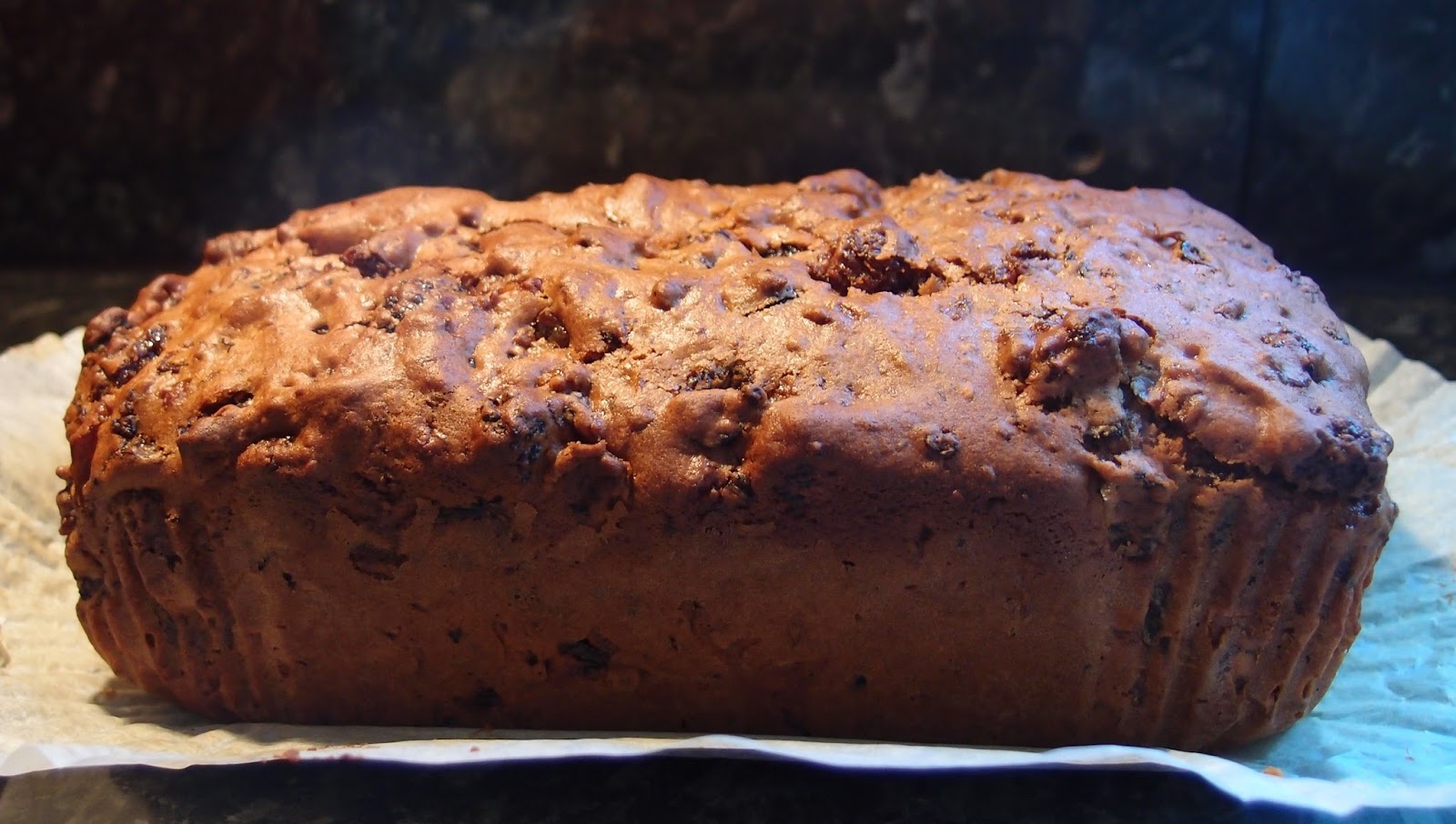
I love bananas but most of my family don’t.  That’s why I don’t bake many banana recipes.  I chose this one thinking no one would know there were bananas lurking but be warned – this tastes very much of banana.


Sometimes banana bread can be a bit dense and stodgy for my taste, and what drew me to this recipe was that the finished article looks more like a tea loaf.  I think the lure of sultanas sold it to me too; any cake or biscuit with sultanas in is instantly healthy and suitable for breakfast.  No dietician in the land can convince me otherwise!


Remember the golden rule when serving this – it must be buttered thickly enough so the eater can provide a set of dental records with every bite!


Because I had 4 over ripe bananas I doubled the recipe and made two loaves.  It did result in a lot of banana loaf to eat but it’s versatile stuff – I’m going to toast it for breakfast when it ages and firms up some more, and I’m also tempted to use it for bread and butter pudding.


Ingredients

75g unsalted butter, at room temperature
100g light brown soft sugar
3 tablespoons runny honey
2 eggs
2 ripe bananas - peeled, destringed and mashed
225g self raising flour
1 teaspoon mixed spice
¼ teaspoon bicarbonate of soda
¼ teaspoon salt
225g sultanas or raisins – I used a mix of the two

To serve: butter


Method

Preheat the oven to 180°C/fan oven 160°C/350°F/gas mark 4.

Line a 900g (2lb) loaf tin with a paper liner.

Beat together the butter and sugar until lighter and smooth – it won’t go fluffy because of the brown sugar and the ratio of ingredients.

Beat in the honey, eggs and bananas.  At this point it will look pretty unsavoury so don’t panic!

Add the flour, spice, bicarbonate of soda, salt and dried fruit and stir until well combined.

Spoon into the prepared tin and level the surface.

Bake for approximately 1 hour or until a skewer inserted into the middle comes out clean.

Leave to cool in the tin for about 30 minutes before de-tinning and leaving to cool completely on a wire rack.

Serve in thick slices, generously buttered.  When (if?) it reaches a few days old it can be toasted as a lovely breakfast treat!

Bask in the glory of the wonderful thing you have created.


Eat.

Sunday, 8 September 2013

Spiced honey loaf


This cake marks my 6th anniversary of blogging and, amazingly, my ‘to bake’ list is perhaps longer today than it’s ever been.  Baking really is a never-ending hobby of loveliness!


Tempted though I was to pick something extravagant and fancy, I was very short of time this weekend and decided to pick something truer to what I consider my baking ethos.  I have always been drawn to the homely, simple and rustic cakes (not that I don’t love a bit of fancy patisserie as well – I am all-embracing where cake is concerned!) and this is a perfect example.


This loaf has a close, dense texture and is perfect to have with a cup of tea.  Being honest, if you were having it sans tea I would be tempted to butter it as it is on the dryer side of cake. The first flavour to hit is the cinnamon before the warm honey cuts in – it leave a lovely taste and makes you want the second bite!


The glaze adds a little texture to the top of the cake.  Putting honey in the glaze enhances the flavour and while the cake is perhaps a plain Jane in terms of looks, it definitely isn’t in terms of taste.


When I think back to my early days of blogging I started with no thought for the future – it wouldn’t have surprised me if I’d quit by Christmas as something shinier caught my attention.  But here I am still, six years on – and there aren’t many weeks I’ve missed a post.  I’d be lying if I said my baking mojo didn’t dip occasionally – I’m going through a bit of a lull at the moment.  My blog is a labour of love but whenever I get a lovely email from a reader telling me about a recipe they made from the site, or asking about how they could adapt a recipe to make their daughter’s wedding cake I get little goosebumps and enjoy a renewed love for the power of baking and sharing recipes – after all, that’s what it’s all about.  I hope you’ve enjoyed my first six years!


Ingredients

For the cake:
225g unsalted butter, at room temperature
115g light muscovado sugar
6 tablespoons runny clear honey
4 eggs
450g plain flour
1 ½ teaspoons baking powder
1 teaspoon ground cinnamon

For the glaze:
115g icing sugar
1 tablespoon runny clear honey
1-2 tablespoons hot water


Method

Preheat the oven to 180°C/fan oven 160°C/350°F/gas mark 4.

Line a 900g (2lb) loaf tin with baking paper.

Beat together the butter and sugar until light and fluffy – don’t skimp on this stage.

Beat in the honey.  My honey was very runny so I beat it straight in, if yours is firmer set warm it slightly first.

Beat in the eggs one at a time, adding a little of the flour if it looks like it might curdle.

Stir in the flour, baking powder and cinnamon.

Spoon into the prepared tin and level the surface.

Bake for 40 minutes before checking that the top is not browning too much.  If it isn’t bake for a further 15-20 minutes or until a skewer comes out the cake clean.  If the cake is browning too much after 40 minutes reduce the oven to 160°C/fan oven 140°C/325°F/gas mark 3 and cover the brown crust with foil before continuing to bake.

Leave to cool in the tin for 15 minutes before turning out onto a wire rack and leaving to cool completely.

Now make the glaze: place the icing sugar, honey and 1 tablespoon of water into a bowl and beat together.  Add a further tablespoon of water if necessary – you’re aiming for a thick, runny – but not watery – glaze.

Spoon over the cake and let run down the sides.  Any of the glaze that runs down the cake and pools around it can be spooned back over the cake (like basting a piece of meat!).

Let the icing set.

Cut into thick slices – butter if you wish – and enjoy with a big mug of tea.

Bask in the glory of the wonderful thing you have created.


Eat.